Fight fire with fire: Inside UK push to develop long-range weapons and counter Russian threat
The UK is on a mission to close a serious gap in its capability to hit distant targets using ground-launched missiles systems.
Partnering with Nato allies, the country is seeking to boost its range of attack to 2000km and beyond as a vital part of national defence against growing Russian aggression.
Deep precision strikes involve advanced weapons like cruise or ballistic missiles, capable of accurately hitting an enemy's high-value targets far from the frontline.
The United Kingdom is part of the European Long-Range Strike Approach (ELSA), a group of Nato countries including Germany, France, Italy, Poland, and Sweden that is using each nation's technology and science base to strengthen the alliance's deep-strike capability.
In a report released last month analysing Europe's ambitions to develop or buy the weapons needed to defend the continent, the International Institute for Strategic Studies (IISS) said deep precision strikes are "in keeping with the defensive nature of the alliance".
The threat of Russia's reach
Europe's biggest adversary is already fielding weapons capable of striking deep within Nato territory, including in the UK.
Russia has shown animosity to the UK for supporting Ukraine, while demonstrating a willingness to use deep strikes against military and civilian infrastructure.
The Kremlin's arsenal of long-range weapons has an imposing reach of at least 3000km through its intermediate-range ballistic missile, Oreshnik, while its ground-launched cruise missile, the Novator 9M729, can also travel up to 2,500km.
The Iranian-designed Shahed, a one-way attack unmanned aerial vehicle, termed Geran-2 in Russian service, has been used extensively in Ukraine, with the drone capable of reaching 2,000km.
The IISS said: "The war in Ukraine has demonstrated both the key role DPS systems can play in modern warfare as well as the threat posed by Russia’s massed use of cruise and ballistic missiles and OWA UAVs."
Deterrence by punishment
Since 2024, the UK has announced three major projects aimed at filling the gap in its capability to deliver deep strikes.
Within the framework of ELSA, Germany and the UK have partnered to create a weapon with a range of 2,000km.
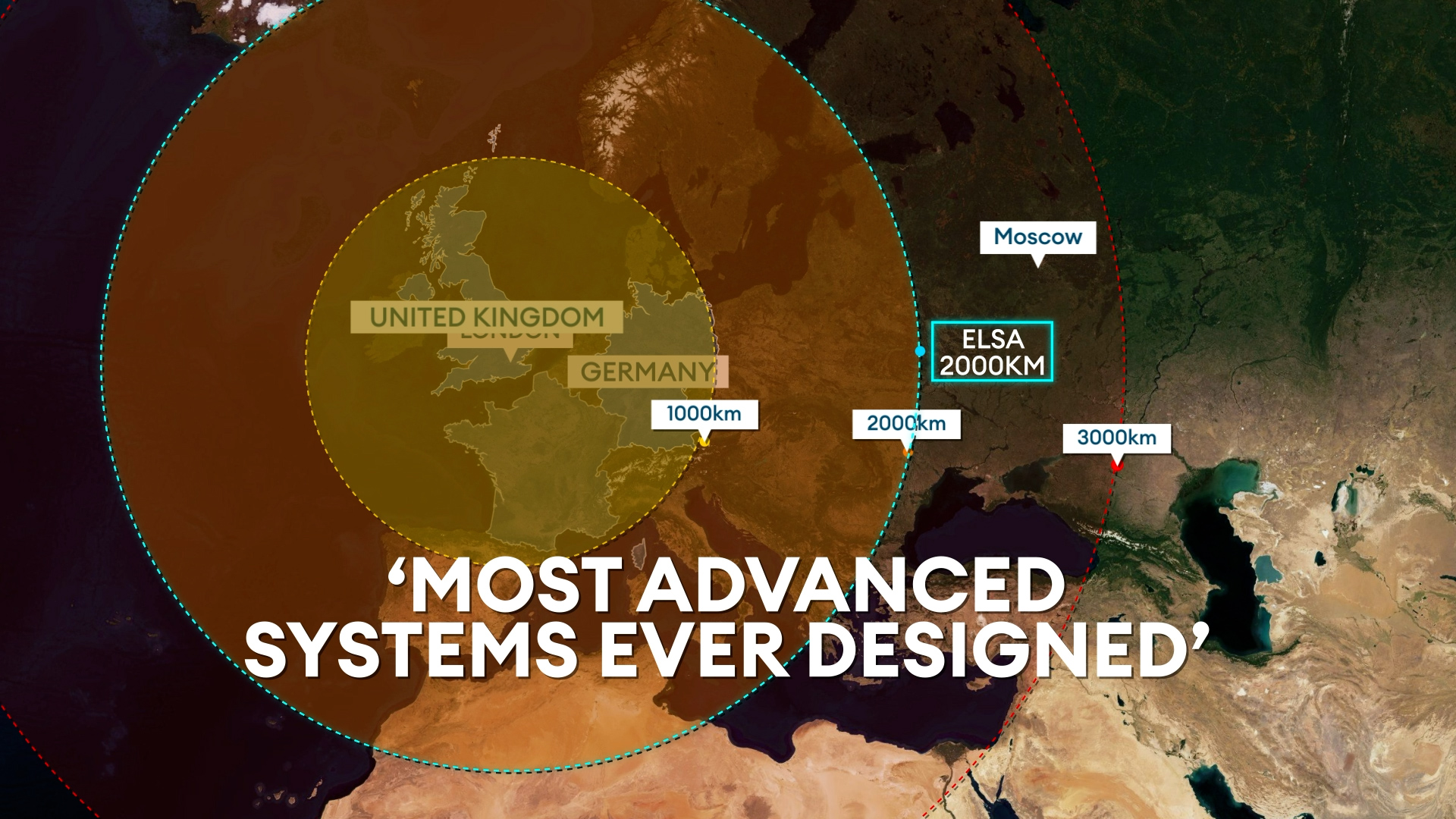
Details are limited, but it's likely to be a cruise or aero-ballistic missile, described as one of the "most advanced systems ever designed".
However, the two nations could also opt for a One-Way Effector, a new type of drone designed for cheaper, long-range strikes that overwhelm enemy defences.
The UK is already independently developing the OWA Brakestop, which will have a range of 600km, launched from a mobile platform on the ground.
In August 2025, the MOD also announced a short-range ballistic missile, ground-launched from a mobile platform with a range of 600km, called Project Nightfall.
If fired from home, the reach would be restricted, but launched from a Nato ally like Poland, the UK could strike deep into Russian territory.
Behind the push to increase Nato's capability is a simple strategy: deterrence by punishment. By developing these weapons, the alliance is seeking to make its enemies fearful that use of their own deep-strike weaponry will be met with powerful retaliation.
Join Our Newsletter