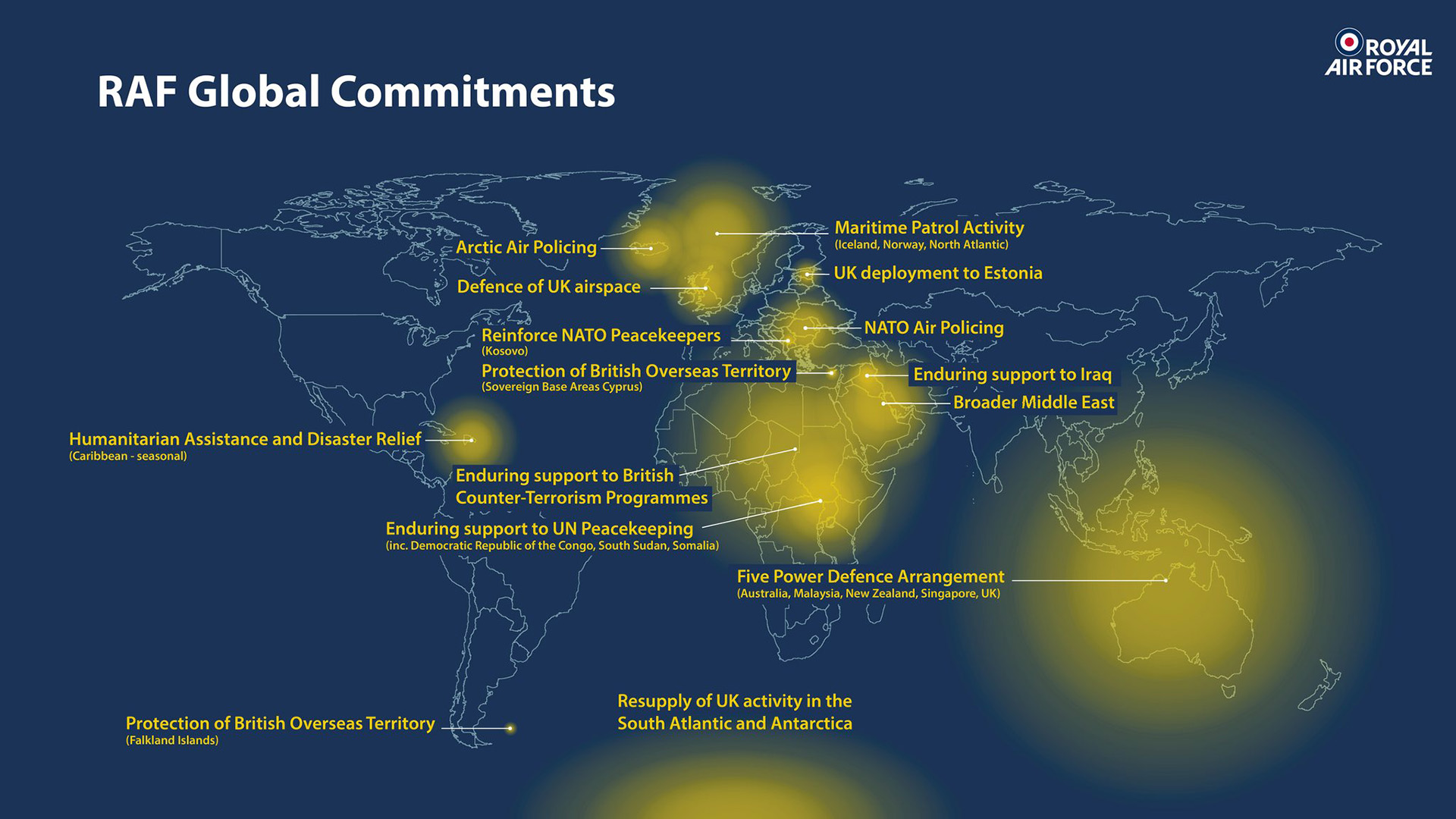
RAF global commitments: Air Force delivering support and protection around the world

The Royal Air Force has a worldwide role, patrolling the skies, defending Britain's airspace, and supporting the UK's defensive missions in the Middle East.
The Air Force continues to interact with the other services, the British Army and the Royal Navy, as it projects the UK's power and capability.
Air Chief Marshal Sir Harv Smyth leads the multifaceted force, which includes the iconic Red Arrows, who fly in their iconic red Hawk T1 jets, as Chief of the Air Staff after taking over from Air Chief Marshal Sir Rich Knighton, who became Chief of the Defence Staff.
BFBS Forces News has looked into the RAF's deployments at home and abroad as it deals with an unstable world.
Arctic air policing (Iceland)
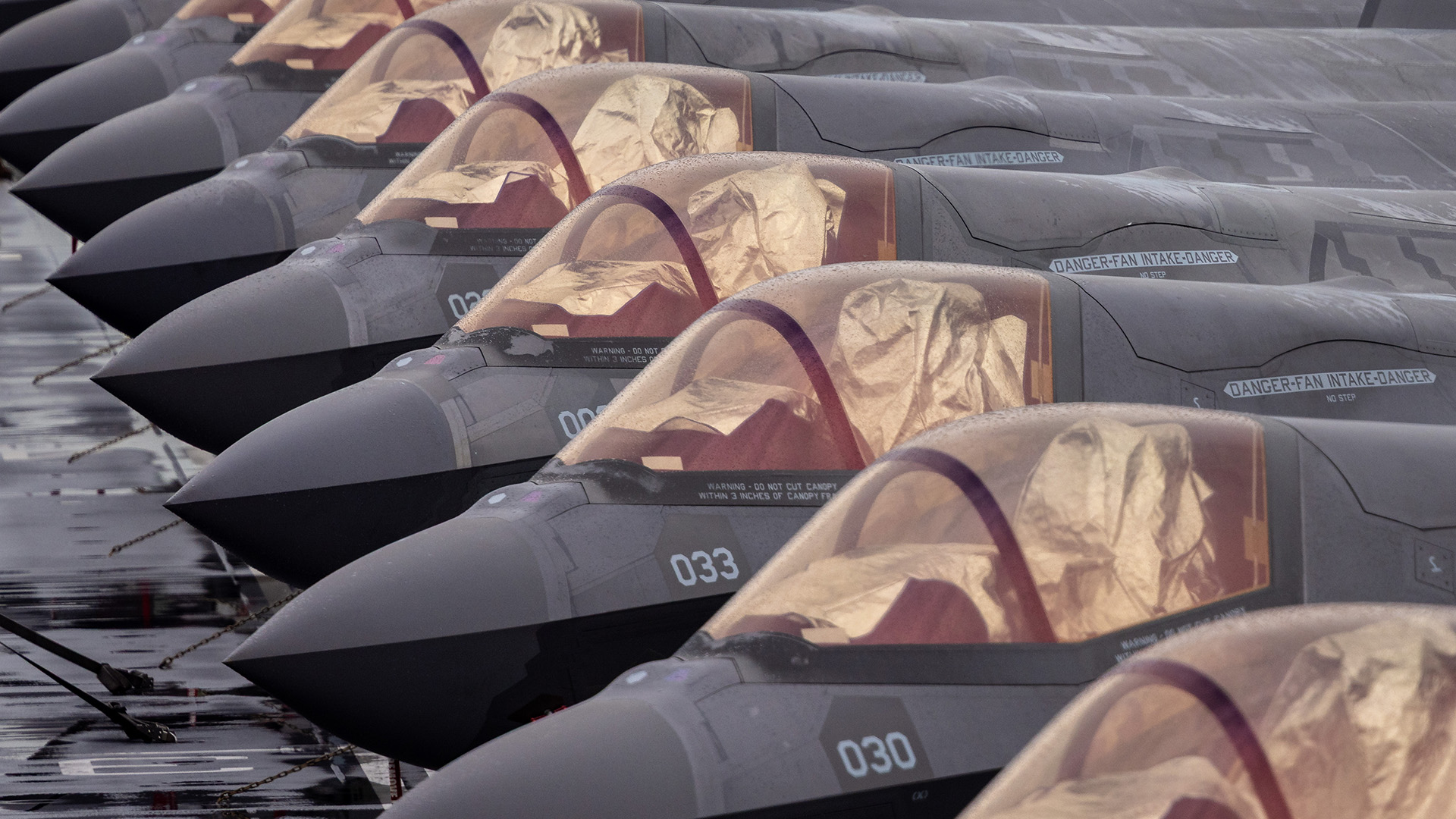
One of the RAF's roles is air policing, which involves aircraft, such as F-35B Lightning and Typhoons, patrolling the skies to deter any foreign military aircraft from encroaching on a nation's or region's airspace.
If there are potential dangerous foreign or unusual aircraft, the pilots have to identify the aircraft, escort it if it is required, and make sure it does not pose any threat.
The UK is part of a Nato mission that has been operational since 2008.
Defence of UK airspace
The RAF defend the UK's airspace from various threats, including uncrewed aerial vehicles and other foreign aircraft, notably from Russia, through the Quick Reaction Alert (QRA).
The QRA is ready to be deployed 24 hours a day, every day of the year, from its bases at RAF Coningsby in Lincolnshire and RAF Lossiemouth in Scotland.
The aircraft scramble to find out about the incursion in the UK's airspace, intercept the possibly risky aircraft and then usher them out.
Maritime patrol activity (Iceland, Norway, and the North Atlantic)
The RAF uses the P-8 Poseidon aircraft, which has a 37-metre wingspan, to patrol the seas, find enemy submarines and aid the UK's nuclear deterrent, Trident.
The aircraft has advanced technology, including the APY-10 radar, to locate and follow possible targets on the water and far beneath the surface.
The aircraft have been deployed to Keflavik Air Base in Iceland as Nato seeks to protect the High North after US president Donald Trump's threats to annex Greenland through various means.
UK deployment to Estonia
RAF Typhoons in the country patrol the eastern border of Nato and respond to potential threats in the exact same way they do when conducting the QRA over the UK.
Reinforcing Nato peacekeepers (Kosovo)
Nato has been organising the operation to support the region through the Kosovo Force (KFOR), which was created in 1999 following the alliance's 78-day air campaign against Yugoslavia.
The government said that the UK Armed Forces would support the peacekeeping mission for at least another three years in October 2025.
RAF logistics helped the last major UK deployment to support the mission three years ago following a violent attack against police in northern Kosovo.
Nato air policing (Romania)
It deploys regularly to Romania as part of Nato's enhanced air policing commitment to the Black Sea region.
Protection of British overseas territory (Sovereign Base Area Cyprus)
The beginning of Operation Epic Fury and Iran's response in late February led the British government to deploy more weaponry, personnel and aircraft to defend British assets in Cyprus.
Security measures were increased around RAF Akrotiri, which is the largest permanent British overseas airbase, following a suspected drone strike by Lebanese Hezbollah at the start of March.
At the base, the aircraft include Eurofighter Typhoons and F-35B Lightnings.
The Ministry of Defence deployed the Orcus counter-uncrewed air system to Cyprus to detect, track and defeat drone threats and Lightweight Multirole Missiles operated by the RAF Regiment.
Support for Iraq: helping support British counter-terrorism programmes
Under Operation Shader, the UK's contribution to the wider Global Coalition Against Daesh mission, the RAF conducts air strikes on ISIS to stop the terrorist group from rising again after its military defeat in March 2019.
The RAF Regiment's Joint Terminal Attack Controllers – specialists responsible for directing combat aircraft to deliver close air support for ground forces – coordinate the missions that represent a key element of efforts to enhance regional stability and counter ISIS in Iraq.
In the decade between 2014 and 2024, RAF aircraft hit some 1,400 targets.
In conjunction with the Iran war, a ground-based British Counter-Uncrewed Aerial Systems unit has been destroying drones launched at coalition forces.
The broader Middle East
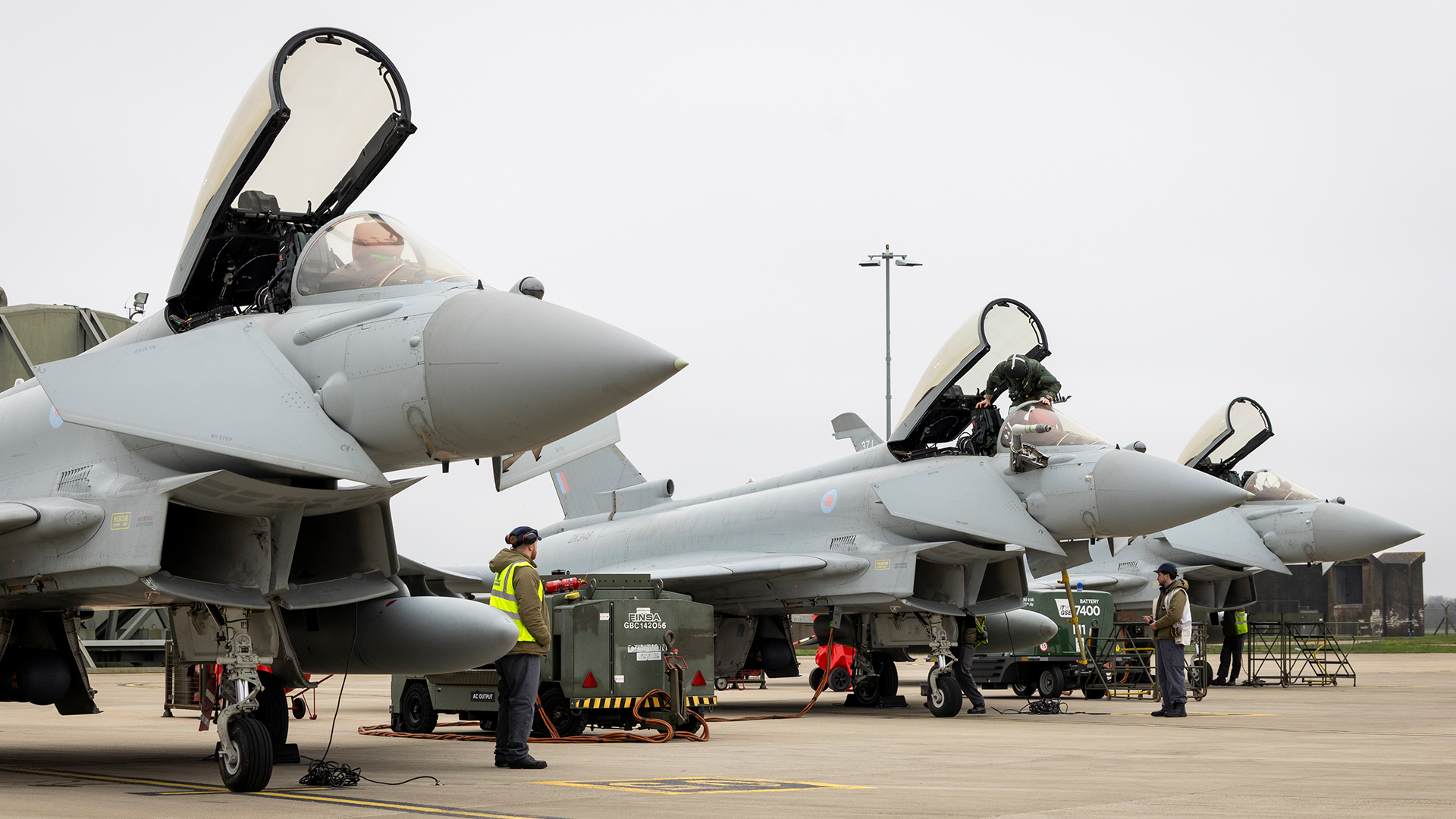
As the Iran war escalated, the RAF has been aiding the UK's allies in the region. RAF pilots have been flying defensive missions to defend Jordan, Bahrain, Qatar and the United Arab Emirates from drone and missile threats.
F-35s and Typhoons have been supported by Voyager aircraft, which are designed for air-to-air refuelling, so the fighter jets can continue their missions.
Around 1,000 additional personnel are reinforcing the defence of British and allied assets in the Middle East.
Among the personnel coordinating the coalition air defence in the Middle East is the Royal Air Force's Air Command and Control Force (Air C2 Force).
The force delivers constant control, coordination and situational understanding to help protect people, assets and airspace.
The detachment combines specialist controllers, surveillance operators and planners who maintain a continuous recognised air picture and ensure the safe use of the congested airspace.
It plays a crucial role in managing aircraft movement, supporting air defence missions such as those flown over the Middle East, and ensuring that all coalition partners can operate together.
Support for UN peacekeeping (including Democratic Republic of Congo, South Sudan, and Somalia)
UN peacekeeping is when a force provides "security and peacebuilding support to help countries make the difficult, early transition from conflict to peace".
The peacekeeping forces enforce ceasefires between warring parties, maintain the safety of civilians, attempt to prevent conflict, reduce violence, increase security in the region, and help national authorities take on these responsibilities.
The RAF deployed medics to the UN peacekeeping mission in South Sudan in 2018.
The 29 personnel ran a military hospital helping international troops protecting victims of the Sudanese civil war, the RAF said.
Five Power Defence Arrangement (Australia, Malaysia, New Zealand, Singapore and the UK)
The Five Power Defence Arrangement (FPDA), which involves the countries above, was started in 1971 to defend Malaysia and Singapore if there was ever an armed conflict against those nations.
The RAF participated in Exercise Bersama Lima last year, when the FPDA conducted a multinational exercise involving over 4,000 personnel.
The air force sent RAF Voyagers, A400M crews, and F-35Bs to the exercise as the defence arrangement worked together.
Resupply of UK activity in the South Atlantic and Antarctica
British forces based in the South Atlantic regularly fly resupply missions to safeguard the UK's involvement in the British Antarctic Territory (BAT).
The Antarctic Treaty, which entered into force in 1961, means that no military activity is allowed on Antarctica, as it is used for scientific research.
The treaty does let military personnel perform non-kinetic tasks, including logistics, research support and search and rescue.
Protection of British overseas territory (Falkland Islands)
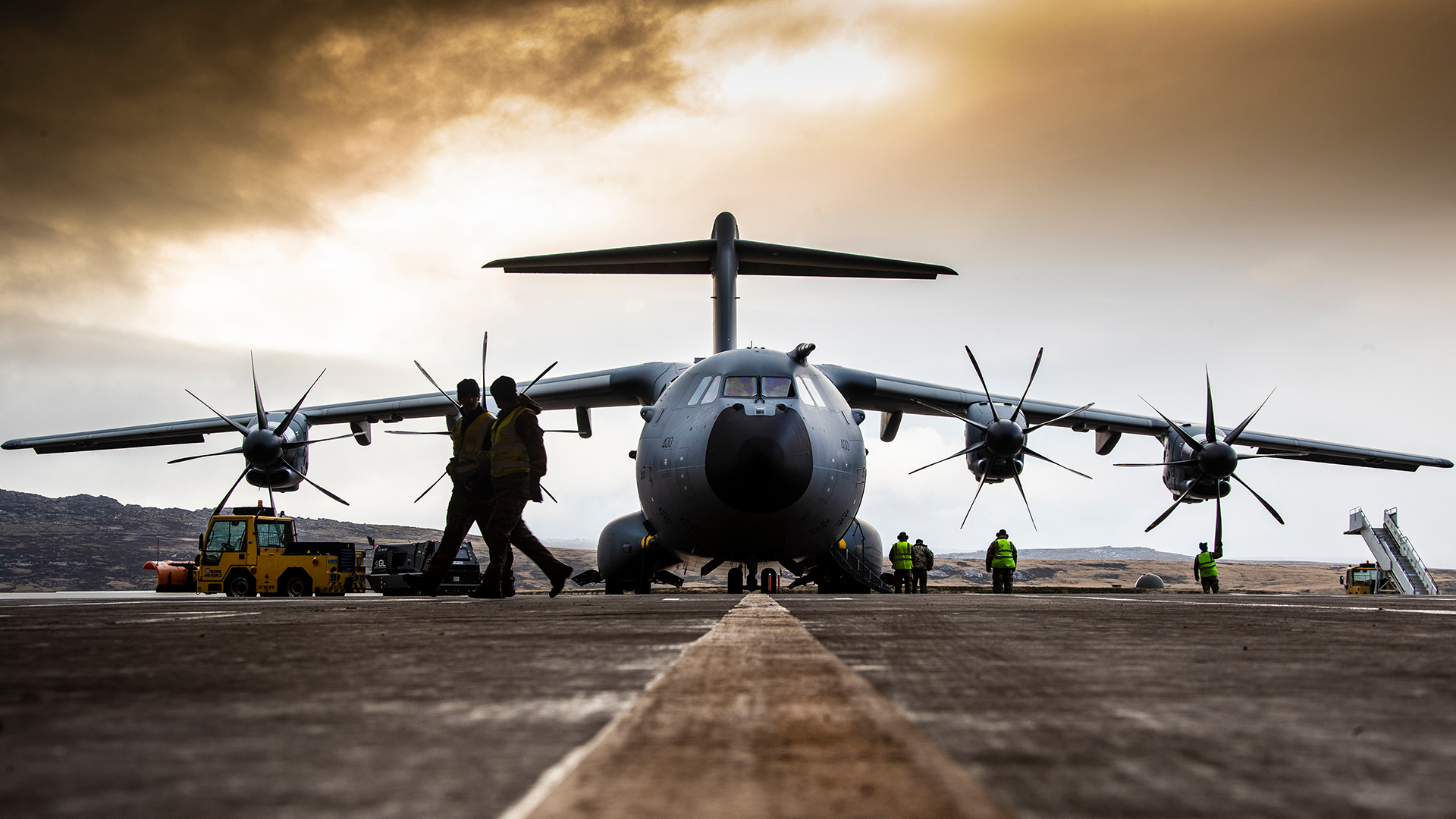
Three years after the Falklands War ended in 1985, the UK established the Mount Pleasant Complex to create a fighter and transport presence.
At the base near the bottom of the world, there are No 1435 Flight, which uses Typhoons, and No 1312 Flight, using a Voyager and an Atlas A400M, according to the RAF.
Humanitarian Assistance and Disaster Relief (Caribbean – seasonal)
The RAF provides humanitarian assistance and disaster relief in the Caribbean after hurricanes, using C-17 Globemaster aircraft and the A400M Atlas.
This type of deployment notably happened in 2017, when it was called Operation Ruman, in light of Hurricane Irma.
The RAF was part of an effort to deliver aid supplies to those affected by the hurricane in the region.
Join Our Newsletter