Epic Fury: Will UK minehunting capability be needed to protect the Strait of Hormuz?
As the war in the Middle East intensifies, protecting global shipping has become an urgent priority.
Iran has threatened to attack any vessel entering the Strait of Hormuz, the narrow maritime corridor through which roughly a fifth of the world's oil and gas normally passes.
The threats have had an immediate impact.
Trump calls on Nato allies to help open the Strait
Shipping traffic through the Strait has fallen dramatically – a mix of fear and cost, with some maritime insurers hiking premiums by as much as 300%.
Now, President Trump is calling on Nato allies to help reopen the waterway by forming an international naval force to police it.
"We're talking to other countries about working with us on the policing of the Strait," Mr Trump told reporters on Air Force One.
The proposal has been met with some scepticism among allies, but if the UK were to participate, the Royal Navy could still contribute several capabilities.
The Strait of Hormuz is one of the most important maritime chokepoints in the world.
At its narrowest, the channel between Iran and Oman is only about 21 miles wide, yet it carries a significant portion of global energy supplies.
Iran could attempt to close it using missile or drone attacks against ships. But naval mines are widely seen as the more serious threat.
Even a small number of mines could force shipping to halt while clearance operations take place.
The UK's minehunting capability
Mine clearance traditionally falls to specialised mine countermeasures ships. But the UK's fleet is limited.
The Royal Navy has seven mine countermeasures vessels, but four are currently unavailable.
The ships that are operational are assigned to home waters, particularly protecting the approaches to Faslane, where the UK's nuclear submarine fleet is based.
That means any deployment to the Gulf may rely on a new generation of autonomous minehunting systems.
These technologies remove sailors from the most dangerous part of the job.
Instead of sending crewed ships into minefields, remote-controlled boats and underwater robots can locate and destroy explosives from a distance.
One system uses remote-controlled boats towing devices that simulate the sound or magnetic signature of a large vessel.
These signals trigger mines lying on the seabed, causing them to detonate harmlessly.
"These are effectively remote-controlled boats that tow coils behind them designed to simulate the sound or magnetic signature of a ship," Pete Sandeman, editor of Navy Lookout explained.
"They trigger mines that have been laid on the seabed."
Finding and neutralising individual mines
Another capability focuses on finding and neutralising individual mines.
Remote-controlled boats tow advanced sonar equipment capable of scanning the seabed.
Once a mine is detected, a small remotely operated underwater vehicle places an explosive charge beside it.
After the robot withdraws, the charge is detonated, destroying the mine.
Trials in recent years suggest the technology could be highly effective.
"I think trials and development over five years have proved that they can do the job better than conventional minehunters with people on board," explained Mr Sandeman.
"You take the man out of the minefield, so you reduce risk."
The Royal Navy is understood to have taken delivery of three unmanned surface vessel systems, each consisting of a control centre, a remote-controlled boat, sonar equipment, and a remotely operated underwater vehicle.
Developed by Thales, the systems were designed for rapid deployment and can fit inside an RAF transport aircraft.
HMS Stirling Castle, the 'mothership'
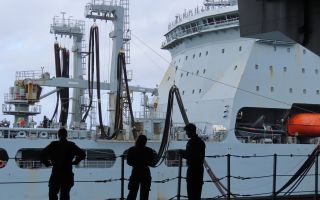
The Royal Navy also has a support ship, HMS Stirling Castle, designed to deploy and recover autonomous minehunting systems.
The vessel acts as a "mothership", allowing the smaller unmanned craft to operate further from shore.
But the concept is still in its early stages.
"Stirling Castle has done very limited trials," Mr Sandeman said. "She's done one basic trial getting the boats on and off."
Even without the ship, the equipment could potentially be deployed from other vessels.
"In theory, you could embark them on vessels of opportunity," he added.
"You could take a support vessel in Bahrain, put a container and a couple of these systems on the back of it and go from there."
Will the UK be part of any international effort to reopen the Strait?
If the UK joins any international effort to reopen the Strait of Hormuz, the Royal Navy could decide to deploy its new autonomous systems sooner than planned.
Mr Sandeman said any decision by Number 10 would likely depend on Iran's forces being suitably degraded, on the provision of some form of close armed overwatch for the Royal Navy vessels, or a ceasefire.
"It would certainly be a baptism of fire if we sent these systems into the Gulf," he said.
Specialist personnel from the Navy's Mine Threat and Exploitation Group are already stationed in Bahrain, and some of the equipment was trialled in the Gulf several years ago.
But the systems have yet to see extensive operational use.
The Royal Navy is widely regarded as one of the world's leading forces in mine warfare, with decades of experience clearing explosives from strategic waterways.
Now, as it transitions toward autonomous technology, the conflict could present both a challenge and an opportunity.
If called upon, Britain may be able to help secure one of the world's most critical shipping lanes – while testing its newest naval systems in real-world conditions.
Join Our Newsletter