UK is in Russia's crosshairs when it comes to undersea warfare, defence committee hears
"The UK is on the frontline."
That was the verdict of one maritime expert called to the House of Commons to brief MPs on the undersea threat to the United Kingdom.
Professor Pete Roberts, an Associate Fellow at Exeter University's Centre for Public Understanding of Defence and Security, explained that Russian attacks on data cables, energy and gas supplies, as well as the UK's natural geography, put Britain in Moscow’s sights when it comes to undersea threats.
"The UK hosts 119 data cables," he told the committee.
"Seventeen trillion dollars worth of trade passes through the UK data cables that are hosted here. It's the gateway to Europe, it's the gateway to the Mediterranean.
"In data-cabled terms, it's the gateway for Europe into the United States. I mean, it's huge... So the UK is on the front line.
"And more than that, President Putin has expressed, both in his doctrine and in his speeches, his desire to strike at the UK directly."
Investment in strategic advantage
Prof Roberts was speaking at a special session of the Defence Committee. He explained that post-Cold War, the Russians invested heavily in submarines, building their present-day submarine fleet to 64, compared to the UK's nine.
Moscow also funds maintenance and a specialist undersea research department, GUGI, both of which have allowed Russian submariners to develop impressive expertise and specialist knowledge.
"It's the breadth of capability they bring. So the ability to operate down to 6,000 metres... and they operate all the time under the ice," Prof Roberts said.
"Their expertise to operate in the Arctic in a really different area... the ability to operate under the ice is very different from operating, you know, anywhere else, North Atlantic or North Sea."
Prof Roberts believes Putin has been weaponising this expertise overseas. Submarine knowledge, traditionally treated like the crown jewels of sovereign capability, is being traded in exchange for military and political advantage.
"It used to be that in order to get North Korean weapons, or North Korean soldiers to fight in Ukraine for him or allow him access in Beijing, he would trade away ballistic missile technology and knowledge. Well, you know, that's... He's done that. That's sort of gone.
"You start to see now what is potentially the leeching and offering of submarine expertise going to states like North Korea and Iran, in exchange for key capabilities."
Maritime understanding is critical
To understand the undersea domain and how difficult it is to track submarines, former Deputy Director of Submarines Commodore (Ret'd) John Aitken says you have to understand the ocean.
"We have invested... heavily in quietening technologies and in ensuring that they're difficult to find. When people look at the sea and water in general, they tend to think of it as a homogeneous kind of body of water. And it absolutely is not," he told the committee.
"It's made up of layers and of salinity, temperature and pressure. And all of those affect the way that sound is transmitted through the water.
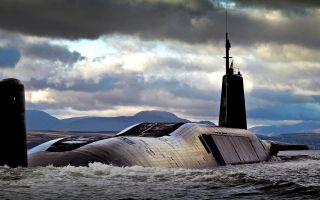
"The invulnerability of the Vanguard-class submarines is absolutely unchallenged, really, they are incredibly difficult to find, even for another submarine. And I've tried! It's the proverbial needle in a haystack."
As China seeks to exponentially increase its military might, Professor Roberts says Beijing’s submarine production and capability has come as a shock.
"The rate at which they're accelerating is shocking. I don't think we've ever seen anything like this in terms of a state developing technical capability as quickly as they have.
"Now, they started from a really, really low ebb, but they have accelerated and grown with speed, and continuing speed, faster than I think we've ever seen in submarine warfare before. Their ability to push out whole submarines at a rate of three, four, five to one against all of the West every year is pretty shocking."
Atlantic Bastion still a long way to go
When asked about the Royal Navy’s response, the panel of experts were full of praise for the Navy’s "world -class" mine hunting capability but scathing about the flagship Atlantic Bastion programme.
Launched last year, Atlantic Bastion combines crewed and uncrewed platforms set up, according to the Navy, in "direct response to a resurgence in Russian submarine and underwater activity."
Professor Roberts admired the vision but expressed concern the programme was under-developed.
"Atlantic Bastion is based on what isn't even an experiment yet. ... Doing it on the basis of a couple of PowerPoint slides and an industry pitch, I don't think is wise."
Former submariner Commodore Aitken agreed.
"I think Atlantic Bastion is a really good concept. But I think currently it relies upon a number of unproven technologies, and you've got to roll sixes to get them right. So, and it's going to be really hard to do."
Both men also questioned a policy focussed on the Atlantic as the Arctic continues to loom large in global significance. The Chair of the Defence Committee thanked the panel for their views and said he hoped the session would help to inform the wider public about the undersea threat, as well as MPs.
Join Our Newsletter