Army completes first phase of land drone swarm project promised in Defence Review
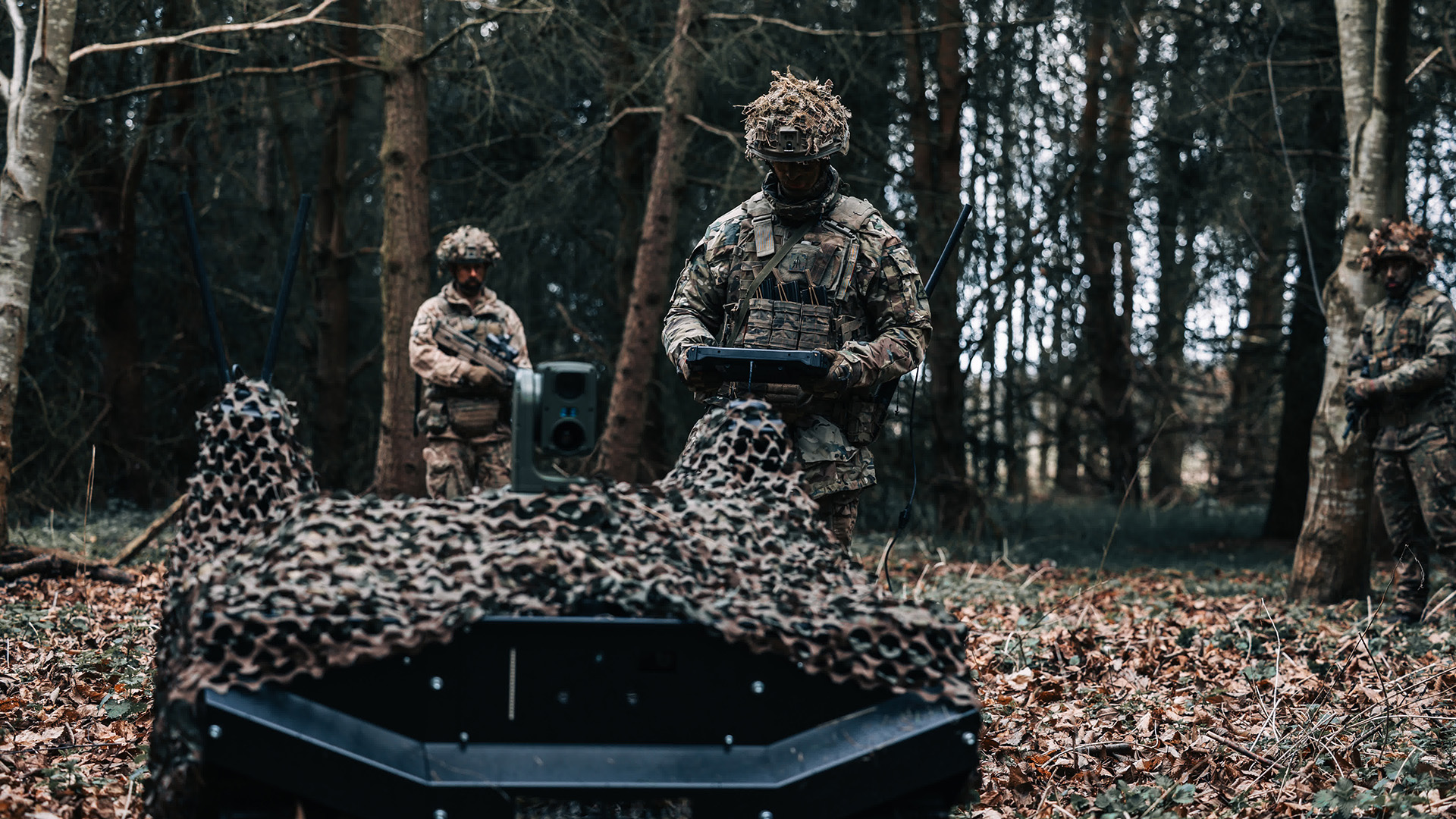
The British Army has completed the first phase of research and development on land drone swarms, one of the technologies named in the Strategic Defence Review's promise to make the Army "10x more lethal".
Armed Forces Minister Al Carns confirmed the progress in a written parliamentary answer after Conservative MP Ben Obese-Jecty asked what had been done to deliver land drone swarms, a year after the Strategic Defence Review was published in June 2025.
Mr Carns said: "The British Army and the Defence Science and Technology Laboratory are progressing a research and development project to deliver land drone swarming capabilities.
- Army pushes battlefield robotics as autonomous UGVs reshape frontline ops
- Robot rescues: How drones and autonomous ground vehicles save soldiers on the frontline
- The age of autonomous combat robots arrives with THeMIS uncrewed ground vehicle
"Phase 1 completed in April 2026 and focused on developing a software defined swarm testbed, which has since been fielded to support ongoing experimentation and capability development," he continued.
What was promised in the Defence Review?
The Strategic Defence Review put drones, autonomy and software at the centre of the Army's future.
In his foreword, Defence Secretary John Healey said: "We will create a British Army which is 10x more lethal to deter from the land, by combining more people and armoured capability with air defence, communications, AI, software, long-range weapons, and land drone swarms."
A swarm is several drones – sometimes hundreds – operating in the same area. It requires systems that can be coordinated, tasked, and controlled together, with software that helps them move and share information as a group.
On land, that is harder than it sounds. Ground systems have to deal with various obstacles, such as mud, trenches, mines, and rubble, as well as jamming.
A flying drone can cross a trench in seconds, while a ground robot has to find a way through.
The review also set out a 20-40-40 model for land warfare. Under that mix, 20% of the force would be crewed platforms, 40% reusable systems such as drones that survive repeated missions, and 40% consumables such as rockets, shells, missiles and one-way drones.
Ukraine's ground robots
The clearest battlefield lesson that the British Army can learn from Ukraine is that frontline ops are moving towards uncrewed systems wherever possible.
Figures published by Ukraine's defence ministry recorded more than 9,000 combat and logistics missions using uncrewed ground vehicles (UGV) in March 2026. Nearly 24,500 missions were recorded in the first three months of the year.
UGVs carry ammunition, water, batteries and medical supplies. They can also bring wounded soldiers back from positions under drone and artillery threat.
The number of Ukrainian units using UGVs rose from 67 in November 2025 to 167 in March 2026.
Ukraine is continuing to expand procurement, with the defence ministry planning to contract 25,000 ground robotic systems by the first half of 2026, twice as many as in the whole of 2025.
Frontline movement has become more dangerous as FPV drones and surveillance systems can track it. UGVs can take on journeys across exposed ground that soldiers would otherwise have to make themselves.
A small tracked or wheeled robot can move a load without risking a driver, stretcher party or armoured vehicle.
Ukraine is also using ground robots for a wider set of tasks, including reconnaissance, mine-laying, demining, surveillance, assault and defensive operations.
How cheap drones reached Russia's biggest targets
The most striking drone footage from Ukraine has usually come from the air or the sea.
In June 2025, Ukraine carried out Operation Spiderweb, using FPV drones hidden inside wooden structures on trucks to strike Russian air bases deep inside Russia.
The targets were part of Russia's long-range aviation force, including aircraft used to launch missile attacks against Ukraine.
Ukrainian authorities said 117 drones were used. US officials later estimated that about 20 Russian military aircraft were hit and around 10 were destroyed.
At sea, Ukraine has used uncrewed boats against Russia's Black Sea Fleet.
Ukraine's military intelligence has credited Magura naval drones with sinking the missile boat Ivanovets, the large landing ship Caesar Kunikov and the patrol ship Sergey Kotov.
In May 2025, Ukraine said a missile fired from a seaborne drone destroyed a Russian Su-30 fighter jet over the Black Sea near Novorossiysk.
Can the UK keep up?
The UK has recognised the drone lesson from Ukraine and has started putting money and trials behind it.
A 2024 Defence Drone Strategy set out £4.5bn over 10 years for uncrewed systems across air, sea and land.
The government is promising to double investment in AI systems through the Strategic Defence Review – from £2bn to £4bn by 2029.
On land, the Defence Science and Technology Laboratory has already tested autonomous resupply vehicles under Project Theseus, and a 2025 Salisbury Plain trial saw one operator control three uncrewed air and land vehicles from a crewed command vehicle.
The Defence Investment Plan, due before the Nato summit in July, will decide which of those ambitions get contracts, production lines and equipment for soldiers to train on.
Join Our Newsletter