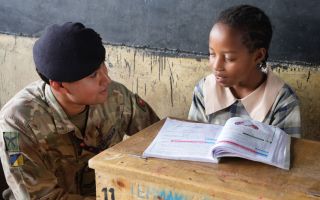
Women serving in the Armed Forces are not small men – and change is on the way
For centuries, women have been largely invisible in data.
Whether talking about product design, medical research or military analysis – there is an unmistakable gender bias.
Why? When it comes to experiments, scientists need to keep everything they can exactly the same – in order to investigate the thing they are investigating.
Women are – broadly speaking – more changeable than men.
They have fluctuating hormones and monthly cycles that could confuse data on things like drug research.
For this reason it was much easier to use men as the default model of a human and apply those results to the smaller version of a man – that is a woman.
But women are not small men, and thankfully the world of research has come to realise this, although it does not change the fact that there is a whopping great gap in women's representation in data.
A lot we just don't know
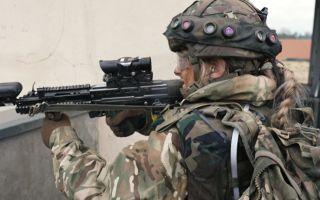
When the Armed Forces were looking to open up close combat roles to women, they realised they had no idea what impact the arduous training that was required would have on women's bodies.
Or just how far women could push themselves physiologically – given they are, as we now know, very different to men.
So the MOD set about investigating.
Over the decade that followed, it funded dozens of research studies to the tune of £20m, examining 22,000 data sets to try to gain a better understanding of its servicewomen.
The findings were fascinating.
The result was not just an appreciation of how women's bodies are different but, in turn, invaluable information on how women can effectively reach the same outputs as men, despite very different and, dare I say it, disadvantageous biology.
To give just one example, women on average have 50% less upper body strength compared with men.
When we consider that 70% of military tasks are upper body (as found by one of the many research studies), getting women to achieve the same level as men sounds like quite an ask.
Add to this the difference in loads carried relative to size.
Me – a 57kg women – carrying say 25kg, is again a very different test to a 100kg man carrying 25kg.
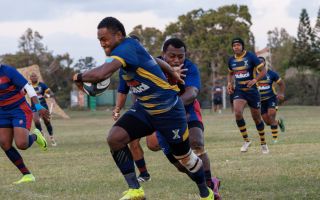
"You never see a female rugby player on a pitch with a male rugby player for a reason, and yet women have to operate alongside men," says Professor Julie Greeves, the Army’s Principal Physiologist who oversaw this huge plethora of research.
Creating a level playing field
But the point of this is not to complain how disadvantaged servicewomen are in military tests.
Or indeed for the grim misogynists out there to tell us women shouldn’t be in the military (and let's hope we don't need to explain that one all over again).
It's to work out how to get women to achieve the same things – and that is entirely possible.
But women need to train in very different ways to men to get there.
"The standards don't need to change, but how a female approaches that start line can look quite different," says Colour Sergeant Lucy Chappell.
Lucy was the first female instructor for Royal Marines Commando training – so whilst no woman has ever passed RM Commando training (aside from All Arms), Lucy has instructed the course.
What every woman (and man) should know
I invited both Prof Greeves and CSgt Chappell into BFBS HQ for a good old natter about the "Guide for Servicewomen Preparing for Arduous Courses" – or rather, to make a chunky podcast about it.
In all honesty, there was a reason I personally wanted to do this.
The MOD has just spent 10 years and a lot of money doing what I suspect no military in the world has ever done before.
From the research, it has worked hard to wrap up the findings in an easy-to-read, nicely illustrated guide.
But now the real work begins.
If we don't find ways to keep talking about it, all that peer-reviewed, critically important science risks staying trapped in a book that few people see.
"There's a lot of material in there that I think every woman should know," said Prof Greeves. "And men," added CSgt Chappell.
"I'm glad you said that!" Prof Greeves added.
A different type of training
In the podcast, we dive into how women need to train differently from men. And that’s not just what they themselves should do differently, but how processes might need to change.
Standard PT sessions, for example, might benefit from focusing more on upper body strength if this is something a large proportion of their personnel need to improve.
Women have smaller bones and different shaped hips, so given the rather uneven playing field on which they perform, they're at much greater risk – two to three times greater – of getting injured.
We go into protection mechanisms – the boring unsexy exercises that should be baked into everyday life to stop this happening (after talking to Lucy – I now stand on one leg whilst brushing my teeth!).
We chat about iron (women need twice as much as men), sleep (women are twice as likely to experience insomnia) and periods (one in four servicewomen have irregular periods or don't have them at all – which is BAD – something which I didn't realise).
We consider toned pelvic floors and how women sweat less than men. Who knew drinking too much water could kill you?!
We even go into things like how to load your bergen to make weight easier to carry, military she-wees and new kit for women.
"For the first time in my career I'm wearing entirely female fitting kit," says CSgt Chappell.
Before you get too excited, that's because at the time of recording Lucy is eight months pregnant.
But both her and Julie say for all the servicewomen out there frustrated after years of wearing uniforms and kit designed for men – SIT TIGHT, because kit for women is just around the corner.
"I think there'll be a time when women will think 'I can't believe our former colleagues never had all of this' – and I don't think that's too far in the future," Julie says.
The MOD's Guide for Servicewomen Preparing for Arduous Courses can be found here.
Related topics
Join Our Newsletter