How the Navy's Black Sea standoff became a wargame over Russian disinformation
In June 2021, an incident involving a Royal Navy warship saw both the UK and Russia battle for control of the narrative.
And that clash has now been turned into a board game, training the next generation to win the story, not just the fight.
The game, which is called Defending Defender, was inspired by the real-life experience of HMS Defender in the Crimean Strait in 2021.
Independent eyes
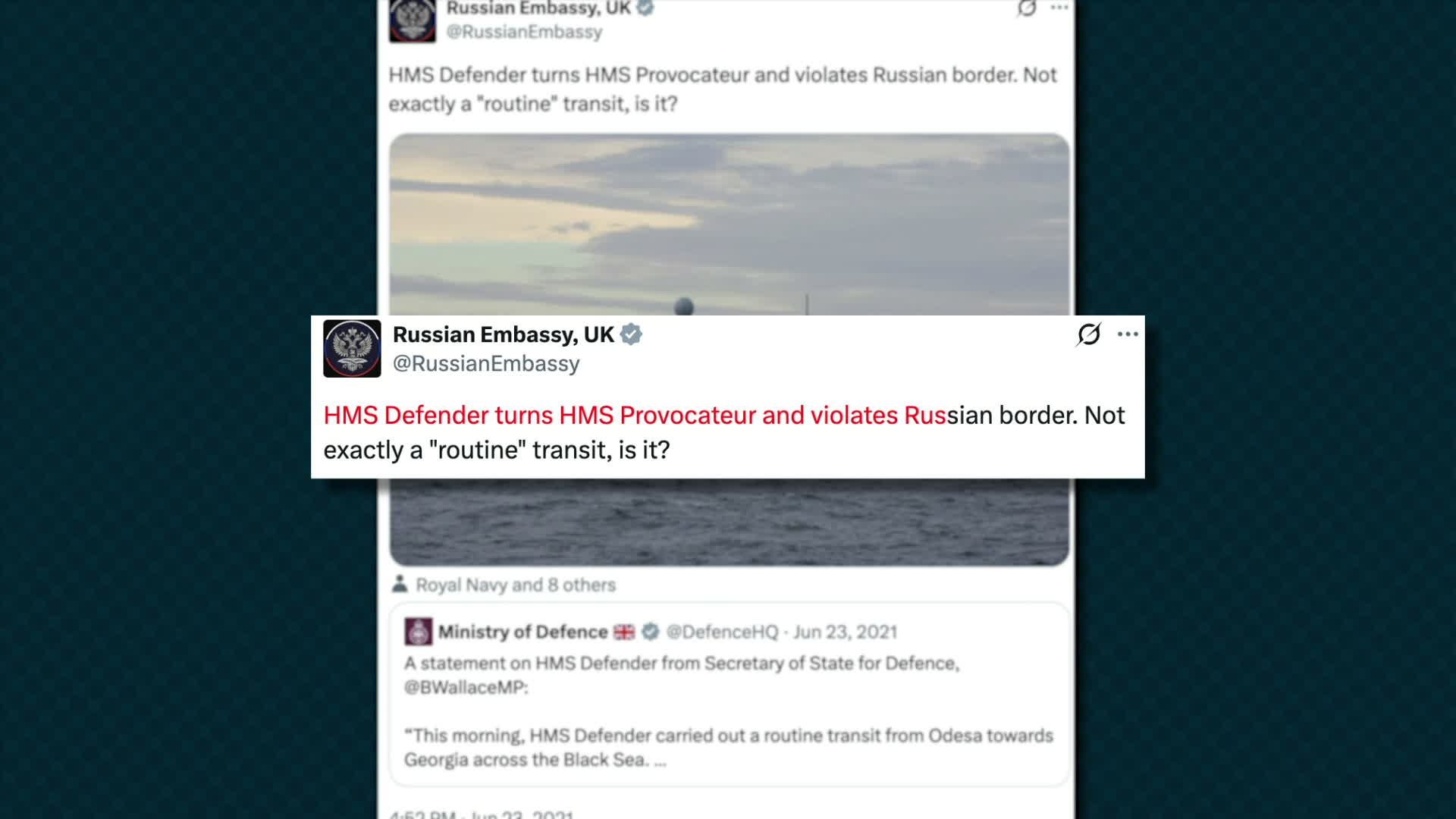
The Kremlin released cockpit footage of the British Type 45 destroyer which it claimed showed the ship fleeing Crimean waters after coming under fire.
The bad news for Moscow was that the sequence of events was witnessed by a BBC journalist on board the ship - and this independent eyewitness account carried more credibility than the Kremlin’s in-house footage.
Even so, the incident prompted a big diplomatic row with the then-UK prime minister and defence secretary and the Russian ambassador to the UK all wading in.
Lieutenant Commander Brian Bennett, who is part of a testing team for the Joint Information Activities Group (JIAG), has been playing the new wargame.
"I remember seeing the footage on the TV," he said. "I remember the reports and remember seeing also what the Russians put out as well from their state media.
"So it was interesting now to play it and then think back to what was happening a few years ago."
A game - with consequences
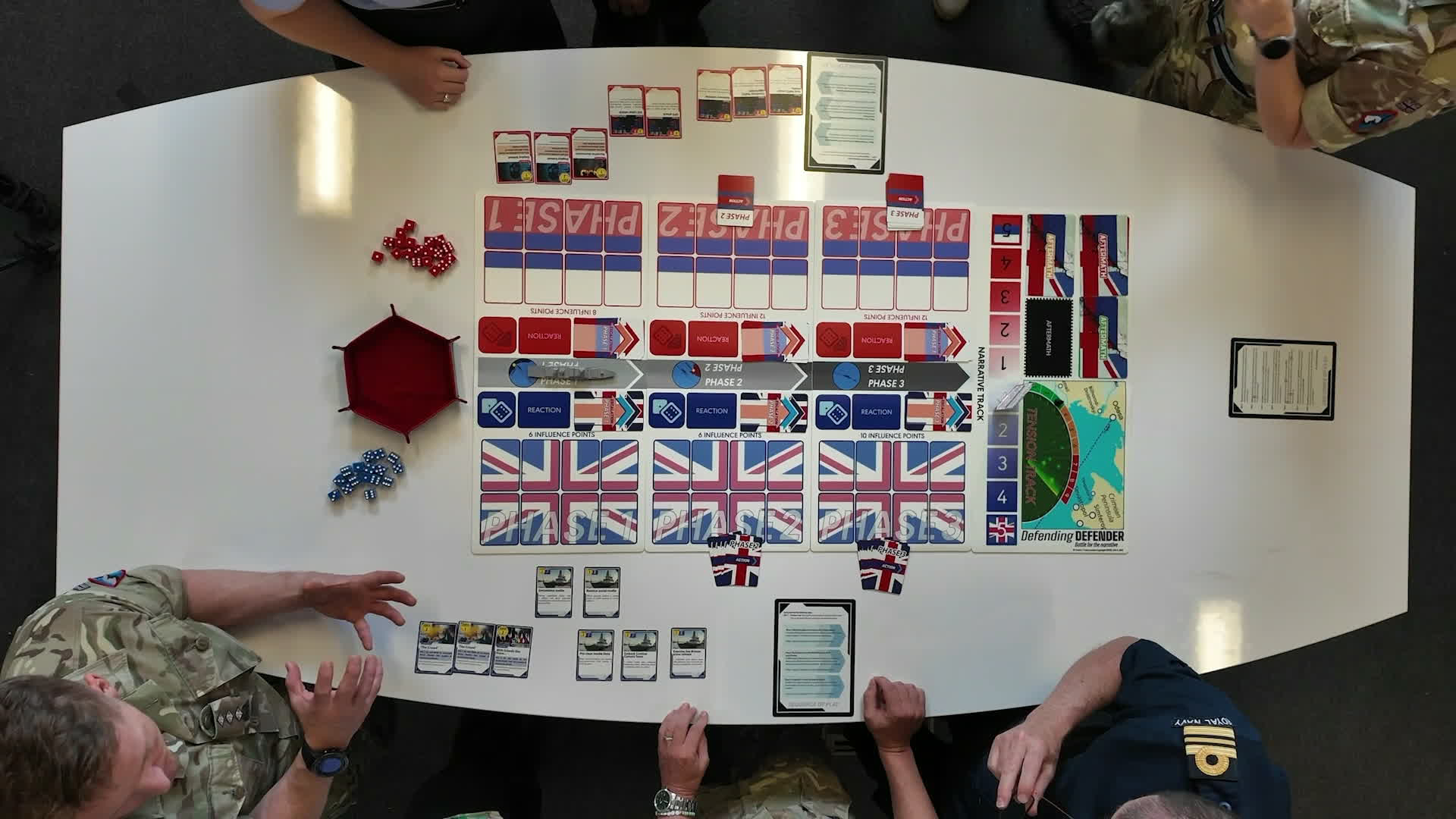
In the board game, two teams representing the Kremlin and the UK compete for control over the story - and every dice roll and card they pick has a consequence.
It’s all been designed by the Defence Science and Technology Laboratory, and Colin Marston, the organisation's head of wargaming, revealed how 1,500 people have already played it.
"We're really confident in the game design for this because of that playtesting," he explained. "Every decision in the design of the game - the colour choices, the cards, the layout of the board - is all done deliberately to enable the players to get to grips with the game really quickly."
Looser rules for the Russian side
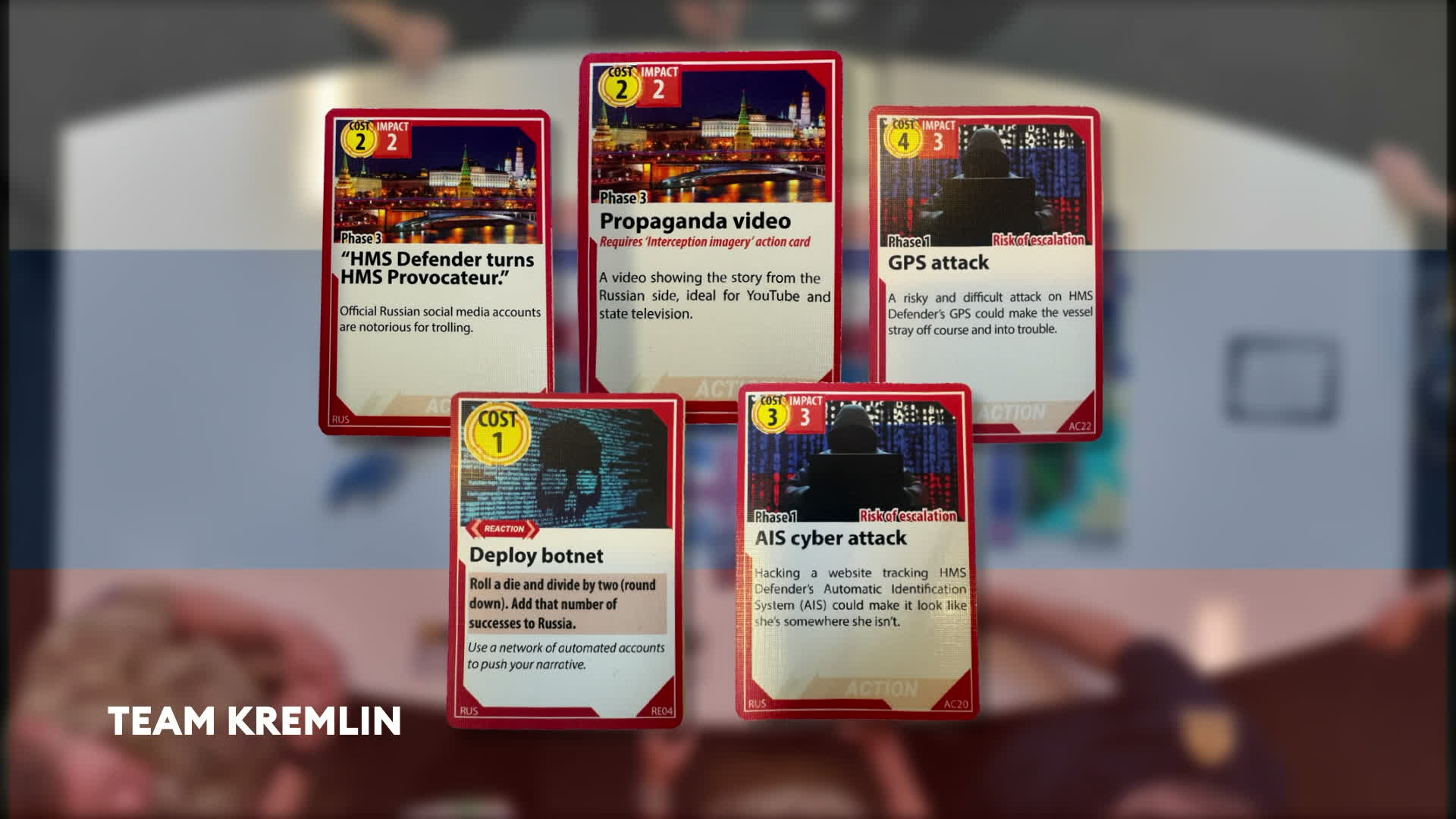
For the team playing as the Kremlin there is more freedom to operate outside the law and the cards they get to choose from reflect this, with options to carry out cyber attacks, release a propaganda video or deploy a botnet.
Flight Lieutenant Howlett explained how this works, saying: "So using botnets, it's something within cyber domain being able to leverage sometimes artificial intelligence to run accounts and to try and amplify a particular narrative or line to take on social media that very often has the effect of making it appear that a great number of people are supporting one particular view, when in fact it's actually artificially created."
The Kremlin’s greater flexibility within the rules of the game is supposed to reflect a real-life imbalance in this space.
But Lieutenant Colonel Faye Johnson, JIAG's commanding officer, doesn’t think Russia has an advantage.
"I feel that our morality is our strength," she said. "Under international law, we can use those tools to show our credibility and authenticity and to be able to drive home our narrative."
I asked her if she thought the UK was winning what she described as the "war for the narrative".
"I think it's a a very close battle," she replied. "I think sometimes it depends on your perspective and your view as to who's winning at any particular point.”
Dstl now plans to roll the game out UK-wide and also share it with 16 allied nations.
Related topics
Join Our Newsletter