Drone race: Turkey's armour-piercer, Russia's entangler and Ukraine's underwater attacker
Ukraine's latest underwater attack drone, known as the Marichka, has been revealed as a system designed to destroy ports, bridges, large ships and landing vessels, with the ability to wait underwater before striking.
With a range of 1,000km, the Marichka can carry a 1,000kg charge, delivered to its target using an onboard inertial navigation system designed to help it remain undetected.
Its engines are specially designed to be noiseless underwater, and it can loiter in one place for days or weeks before it strikes.
- Ukrainian drone firm attacked by Russia – so it opens a factory in the UK instead
- Airbase evacuations begin after RAF Akrotiri airfield hit with drone attack
- Special delivery: Marines let the drone take the strain with mortars and machine guns
In the air, Turkey has showcased its first armour-piercing FPV – or first-person view – drone under development.
Footage shows it being tested for the first time using a military standard fuse integrated armour-piercing munition, successfully striking a designated armoured target.
Its makers called it "pinpoint accuracy on the first shot", and observers later confirmed it penetrated the target's armour.
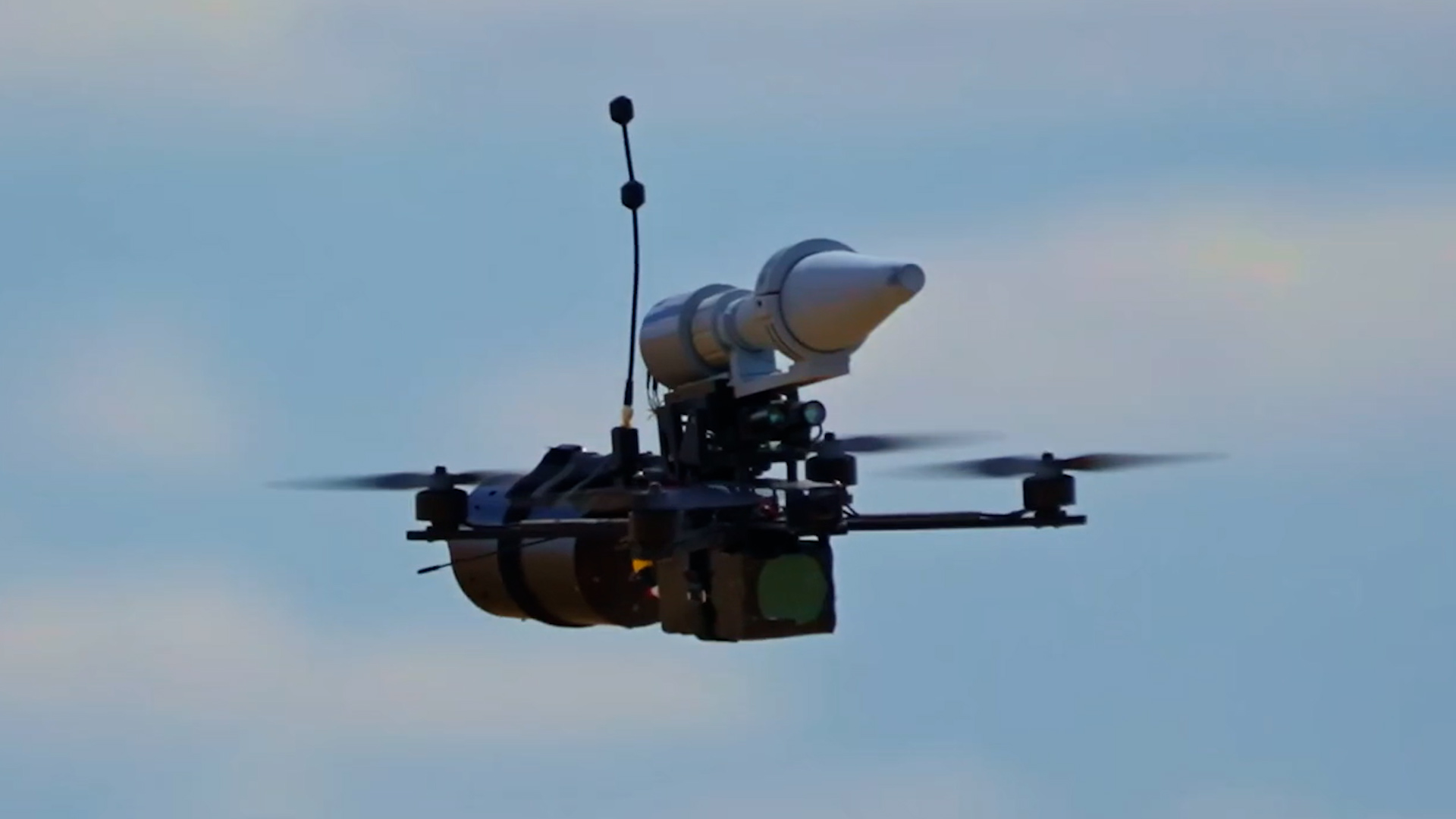
Known as the Kargu FPV, it has a range of 10km and a mission duration of more than 20 minutes in kamikaze mode, and up to 45 minutes in observation mode without ammunition and fuse.
It can reach an altitude of 5,500 metres, but flies at 500 metres for missions, reaching a top speed of 160km/h.
Its payload can switch between anti-personnel and armour-piercing warheads, and it is linked by fibre-optic cable.
Russia, meanwhile, has been shown using an "entanglement drone", a simple, low-tech way to target enemy quadcopters.
The drones hover above a target and dangle a line until it becomes caught in an enemy drone's blades, with a magnetic join designed to let the line break on contact so the attacking drone is not pulled down as well.
Related topics
Join Our Newsletter