New tech will help cut through the clutter and find the right target, Army officer says

The military's use of data, sensors and drones will make targeting the enemies on a contested battlefield a much cleaner process, a senior officer has told BFBS' Sitrep podcast.
The digital targeting web, which is scheduled to be delivered next year, will connect the Armed Forces' weapons systems more effectively, to both suck up and process huge amounts of data across all domains.
The Army's key pillar of that web is the Land ISTAR (intelligence, surveillance, target acquisition and reconnaissance) Programme, which will help digitise the Army by combining data sources and enabling quicker decision-making.
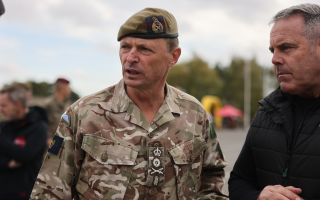
BFBS' Sitrep podcast, hosted by Professor Michael Clarke and Kate Gerbeau, spoke to Colonel Kieran Phillips, Commander of the Multi-Domain Operations Group, and Brigadier Matthew Birch, Senior Responsible Owner of the Land ISTAR Programme, about how technology is changing soldiering.
Data
Speaking about the sheer volume of data that is being ingested by the Armed Forces, Col Phillips said it "is a real battle-winning advantage piece for us".
Part of digitising the Armed Forces is ensuring that personnel receive suitable data for their operations, rather than just a bundle of data that they have to sift through to find what they actually need to know.
"I want all of the information that's available, but I want it to be processed at machine speed so that it gets in the right format to the right people at the right time to be of best use," Col Phillips added.
"I don't want cognitive overload."
Targeting on a busy battlefield
By digitising the Army, it is hoped that soldiers will be able to use data and sensors to target their enemy faster than before, thereby raising their lethality.
The Army aims to double its lethality by 2027 and triple it by 2030.
Asked by Ms Gerbeau how the job of soldiering will change, Col Phillips said: "I think an increased lethality. So, that amount of sensor alignment removes a lot of battlefield confusion and cluster and allows us to be more precise with our effects. So, it's a clever way of using the resources that we have at our disposal."
These sensors and information could also prove game-changing on the battlefield, as they will help soldiers receive information from all levels rather than just from their immediate region.
"If you think they're very small and localised and if you're getting targeting information at the speed of relevance that tells you where to look, where there's a threat, where there's an opportunity: that's the true difference," he explained.
You can listen to BFBS' Sitrep wherever you get your podcasts, or on BFBS Forces News YouTube channel.
Related topics
Join Our Newsletter