UK to start producing Ukrainian sea drones that helped destroy Russia's Black Sea Fleet
Magura uncrewed sea vessels (USVs) have sunk Russian warships, shot down aircraft and helped transform naval warfare.
Now £113m of UK investment will bring their production and engineering to Britain.
The Government-backed National Wealth Fund is investing the money in Ukrainian defence company UFORCE as part of a wider funding round worth more than £525m.
Warrior goddess proves her worth
The cash will support a major expansion of the company's UK operations, bringing production, engineering and advanced manufacturing to Britain.
UFORCE says the expansion will create hundreds of highly skilled jobs in areas including software, artificial intelligence and engineering.
It also plans to build a British supply chain, with more than 70% of the content of each UK-built boat coming from UK suppliers.
The Magura – named after a Slavic warrior goddess – first attracted international attention in May 2023 when three of them attacked and damaged the Russian intelligence ship Ivan Khurs in the Black Sea.
Nine months later, in February 2024, that same technology was used to make naval history.
Magura V5 drones were used to destroy the Russian missile corvette Ivanovets and the large tank landing ship Tsezar Kunikov.
It was the first time uncrewed surface vessels had sunk enemy warships in combat.
The attacks demonstrated how relatively small, inexpensive sea drones could wreak havoc on a conventional navy.
Since then Ukraine has used the Magura family in a series of operations against Russian naval and air targets.
UFORCE says the vessels have contributed to the destruction of more than a dozen Russian warships and have shot down multiple helicopters and fighter aircraft.

Making good even better
The newer Magura V7 has taken that capability further.
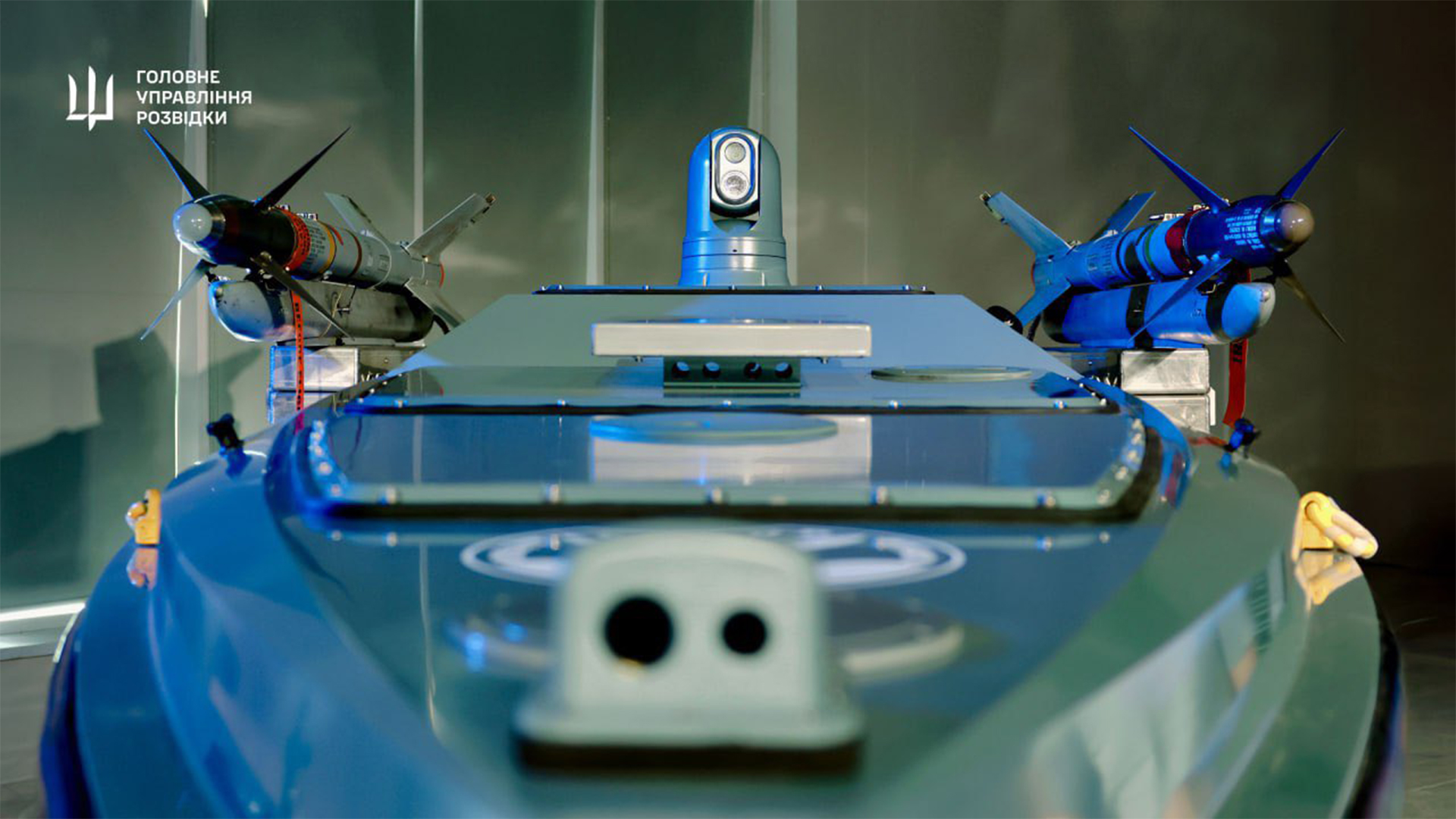
In May 2025, V7 drones armed with American-made AIM-9 Sidewinder air-to-air missiles reportedly shot down two Russian Su-30 fighter jets over the Black Sea.
But the Magura is not simply a one-way attack weapon.
Depending on the variant, it can carry out reconnaissance, surveillance, patrol and search-and-rescue missions as well.
Maguras can also act as mobile maritime launch platforms for other weapons.
Ukrainian forces have used them to launch Nemesis long-range strike drones against Russian air defence systems.
The original Magura V5 is 18 feet (5.5m) long and has a reported range of 400 nautical miles, with a top speed of around 42 knots.
Weighing just over a tonne, they are thought to cost around £200,000 each and are fitted with GPS and inertial guidance systems.
The Magura can also be guided visually via its two electro-optic cameras.
The vessels can be armed with 300 kg of explosives for one-way attacks.
Maguras have also been fitted with machine guns, anti-tank guided missiles and surface-to-air missiles.
The larger V7 version offers a greater range of 800 nautical miles, plus increased payload capacity and better performance in rough seas.

A two-way street
The latest UK announcement underlines how the relationship between Britain and Ukraine is changing.
During the early stages of the full-scale invasion, the UK was supplying weapons, training and equipment to help Ukraine resist Russia.
Now, Ukrainian companies are bringing their battlefield experience and technology to Britain.
Defence Secretary Wes Streeting recently got a demonstration of what that can mean in practice.
Aboard HMS Prince of Wales in Norway, he remotely piloted a UFORCE MV7 – part of the Magura family – that was located 1,500 miles away off the coast of Portugal.
The UK says the investment will help strengthen its own defence industrial base, while supporting Ukraine and other allies, particularly countries operating in Northern European waters.
UFORCE will also develop apprenticeship schemes with universities and colleges across Britain.
The investment forms part of the UK-Ukraine 100 Year Partnership, an agreement intended to deepen cooperation between the two countries across defence and security.
Related topics
Join Our Newsletter