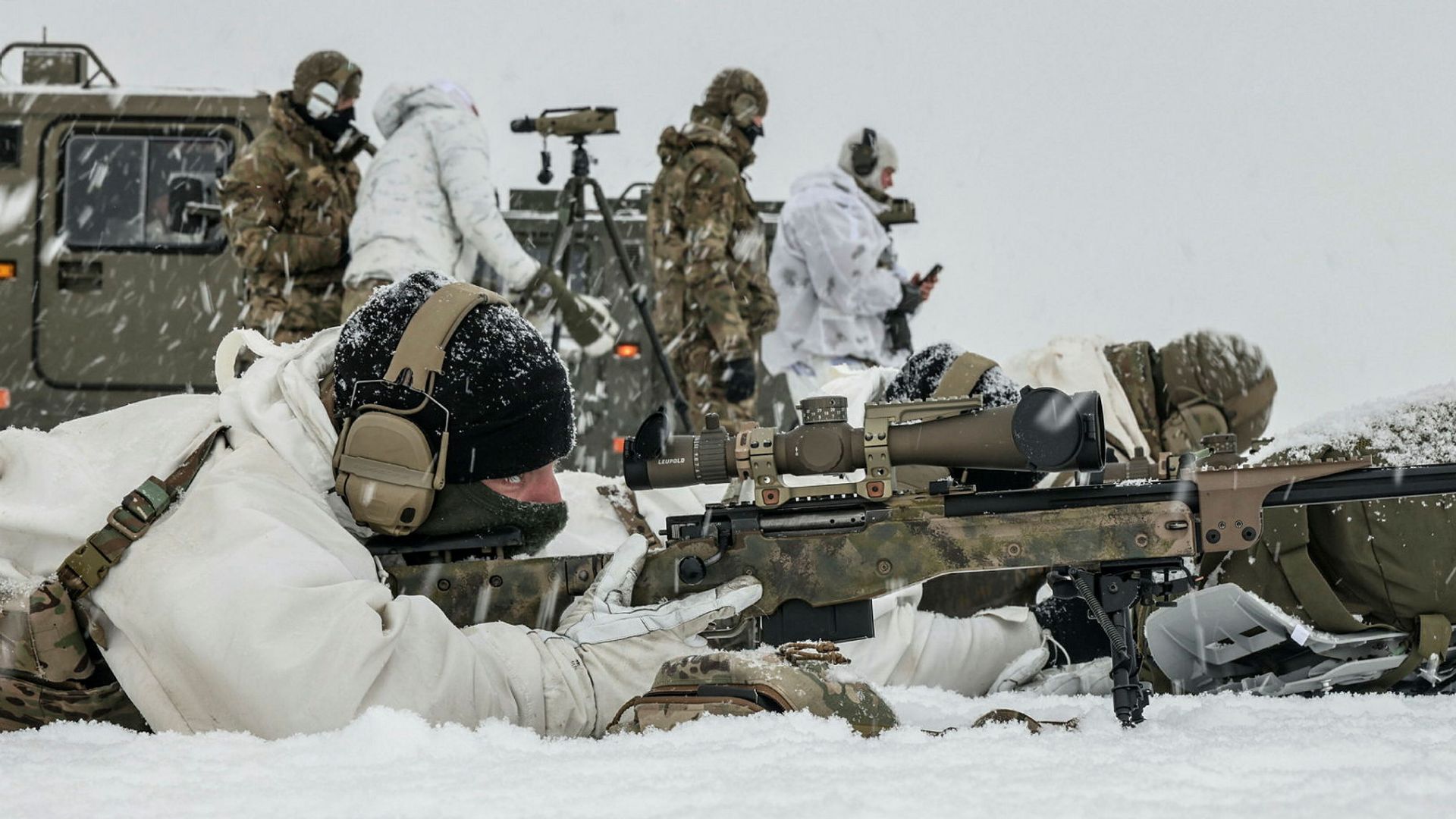
The booming sounds of artillery and mortars overhead, the crackle of machine gun fire whizzing close by and the continuous drone of tank engines: the sounds experienced in conflict are as deafening as they are deadly.
Approximately 300,000 UK veterans suffer from noise-induced hearing loss (NIHL) or tinnitus due to service-related, long-term exposure to explosions and gunfire, according to research by the Royal British Legion.
And under a recent landmark ruling, former Royal Marine Christopher Lambie and ex-soldier Jack Craggs were awarded £131,150 and £19,445 respectively from the MOD for NIHL, paving the way for future claims.
Seeking accountability
Approximately 8,000 of the 10,000 claimants bringing legal action against the MOD are represented by a single law firm, Hugh James.
Under the Matrix Agreement, led by the solicitors' firm and approved by the High Court in 2024, service personnel who served on or after 15 May 1987, can now secure compensation without lengthy litigation.
They will now only need to prove that any hearing loss was sustained during their time in the military.
As Simon Ellis, a partner at Hugh James, explained to BFBS Forces News, the key advantage of the agreement is that anyone bringing a claim under it will not need to prove that the MOD is at fault.
"There is no worry about proving their claims being brought in time or proving that they weren't partly to blame for the hearing problems they sustained, because the matrix gets rid of all that in a stroke," he said.
"It also means that they don't have to worry about going to court to prove those elements of it."
Landmark ruling
At a trial last year, Mr Lambie and Mr Craggs acted as two 'test cases', laying the foundations for diagnosing NIHL and valuing loss of earnings.
In a ruling last week, the MOD paid more than £150,000 to the two veterans.
Lawyers for the MOD accepted it had a "duty of care" towards personnel amid legal claims brought by former members of the Armed Forces who suffered hearing loss, having disputed this in earlier legal action.
While the MOD accepted noise exposure during service caused hearing loss among former personnel, it may dispute the extent to which this happened in individual cases.
Following the ruling, Mr Ellis called on the department to establish a compensation scheme before a deadline in July, emphasising that "time is running short".
"The Ministry of Defence has already acknowledged that it owes a duty of care to service personnel, and many of those with hearing loss have already waited years for answers," he said.
"Now is the time for them to come to the table and work out a scheme to agree on compensation and avoid a further lengthy and expensive legal dispute."
'I was none the wiser'
A previous claimant, Stephen Hambridge, was diagnosed with NIHL and tinnitus during his service in the British Army in 2012, leading to a permanent medical downgrade which ultimately ended his military career.
The 46-year-old told BFBS Forces News that he had lost "a big chunk of his life" due to his diagnosis, and although he cannot pinpoint a specific cause, he believes it may be linked to his time while on deployment in Afghanistan, where he served as a mortar fire controller.
"I had two radio nets on, one for each ear. One would be to mortars, and one would be back to Battlegroup HQ – there was no space for any ear defenders," he explained, adding that it was not possible to wear a helmet with them in place.
"They did give us the little foam ones when we were out there, but once they had been on the floor, you couldn't really use them again without getting any dirt in your ears – so the hearing protection couldn't be used there," he added.
Mr Hambridge said that despite experiencing tinnitus, he was "none the wiser" that his hearing was beginning to deteriorate.
Transferring to the Corps of Royal Engineers in 2008, he was preparing for his third tour of Afghanistan when he failed the pre-deployment hearing test. He subsequently found himself medically downgraded.
"Seeing that my hearing was damaged, [and] according to them, I couldn't be near any loud noises or vehicles – it just meant doing guard duties and staying back at camp, which wasn't my thing," he said.
Despite intending to serve 'the full 22,' he opted to take a redundancy package. Having received limited support after leaving the military, along with only a small payout, he felt there "should have been more to it".
"I spoke to Hugh James and explained, down to every detail. I lost a bit of my life because of this, and going through what I've gone through," Mr Hambridge said.
"It took me seven years to get my claim to where it was – Covid was a big factor in that – but there is light at the end of the tunnel."

'Don't delay'
The deadline for bringing claims under the Matrix Agreement has been extended until 31 July 2026.
Mr Ellis explained that unless the deadline was extended, those wishing to claim under the framework will be prevented from doing so.
"My message is don't delay," he said. "Get the claim in, get it registered, and at least then your position is protected, which means that when these cases get worked through, your case will be considered as part of the cohort."
Mr Ellis also urged those who have previously been rejected by the MOD's War Pension Scheme or Armed Forces Compensation Scheme to apply.
According to Hugh James, awards through the MOD schemes can be as low as £6,000, while the legal route can also include claims for loss of earnings over the years since hearing damage developed.
Related topics
Join Our Newsletter