WW2 Liberty Ship's masts removed to prevent potential explosion in Thames Estuary
It's just after 8am and I'm standing about 200 yards offshore on what is known as Queenborough All Tide Landing in the Isle of Sheppey.
It describes perfectly what it is – a place where you can get a fairly large boat in, despite the tide being way out.
A short way off, a catamaran is making good speed towards me, my camera operator Chris Giles and about 10 workers who are heading out to our ultimate location, the wreck of the SS Richard Montgomery.
Once boarded and issued with a lifejacket, I ponder the fate of the ship, as we make our way into the Thames Estuary and towards its final resting place.
SS Richard Montgomery was a Liberty Ship. They were built at great speed in America, originally designed to replace lost British cargo ships.
On 20 August 1944, SS Richard Montgomery was at anchor just north of the Nore Sandbank. To give you an idea of where that is, roughly to the north is Southend, in Essex. To the south and far closer is Sheerness in Kent.
She'd anchored as per the instructions of the harbour authorities, but that anchor started to drag – which means it didn't hold on to the seabed.
No one noticed and the ship ended up on the Nore sandbank, broke in half and sank.
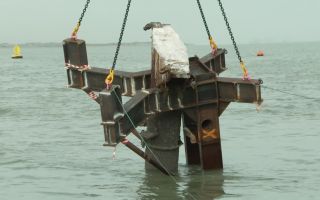
About half of her cargo of explosives was removed soon after, but the rest had to be left, leaving 1,400 tonnes in her hold and three masts sticking a long way out of the water.
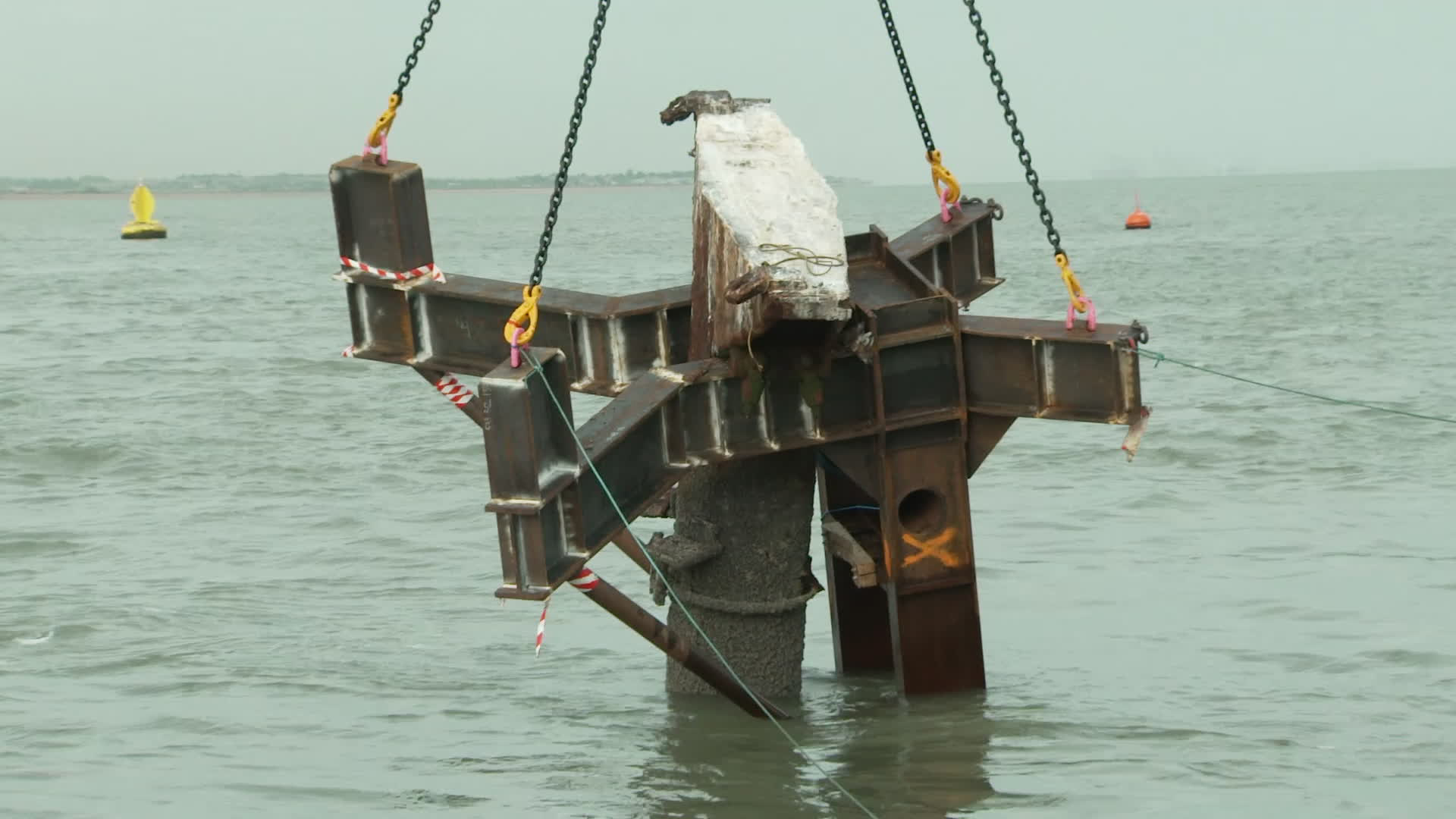
Our catamaran reaches the Nore sandbank, and we see two of those masts and a giant barge. The workers depart and I speak to naval architect Nolan Conway from the Resolve Marine Group.
Nolan explains that the explosives won't have been affected by the sea water and are still dangerous.
The masts are strong, but where they attach to the rest of the ship is weak and this could send them crashing down. The result could be a massive explosion.
Nolan told me: "What type of munitions could be out here? There's PXO, UXO, unexploded ordnances, all different types of things between German offensive mines, British defensive mines, air drop bombs, anti-aircraft munition.
"So it's not just the explosives on the wreck that we're worried about. It's the stuff in the area that the barge could impact, that could create a sympathetic detonation on a wreck."
The aim of this project is to remove the masts and make the wreck safer. On my visit, the first was already down.
Watch the video to see this happen and understand the true complexity of the undertaking the team faces.
Join Our Newsletter