In his own words: the man who dropped the nuclear bomb
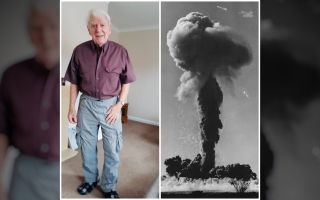
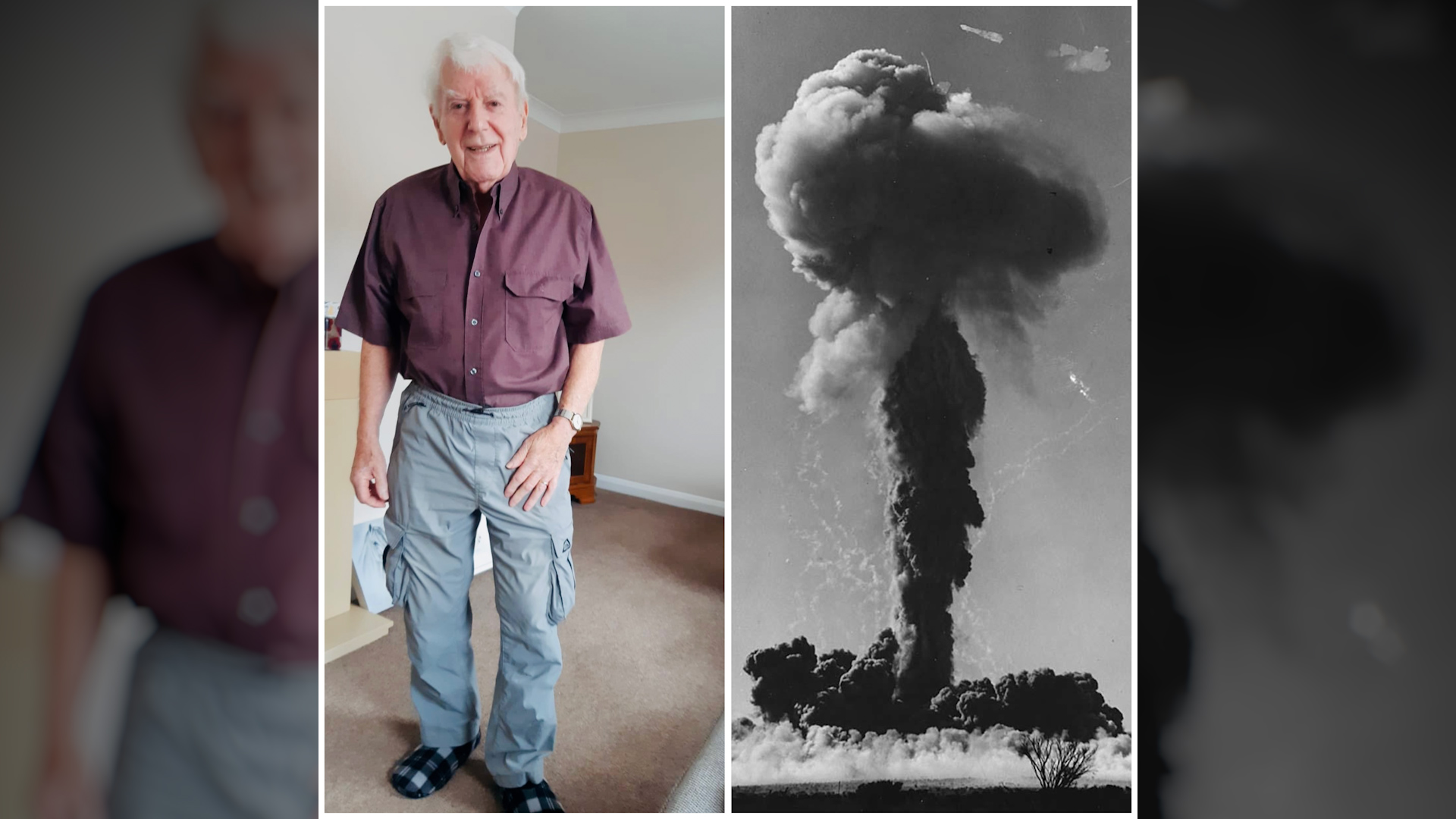
Bryan Roth is almost 89. On his 20th birthday, he dropped a nuclear bomb the size of Hiroshima on a place in South Australia called Maralinga.
Bryan was one of 22,000 servicemen who took part in Britain's nuclear test programme.
The government is now said to be considering a possible payout of £30,000 to veterans involved in the tests.
- How Sweden Almost Got The Bomb
- Dreadnought drive: PM recommits £8.4bn investment into UK's nuclear deterrence
- Why does the UK spend 25% of its defence budget on the nuclear deterrent?
Both the US and Russia already compensate those involved in theirs.
In a special interview with BFBS Forces News, Bryan told us his incredible story – how he dropped three bombs and witnessed the aftermath, the moment when things went horribly wrong, and his shock at how the MOD has treated veterans like himself.
He says he is one of the lucky ones. Several of his friends died soon after returning.
Only around 1,200 veterans remain. Most are old and sick. Many are still fighting the government for compensation.
This is Bryan's story…
I'm talking to you because I want to tell people how disgusted and how upset I am with everything from start to finish.
I was called up into the Air Force in 1956 and in July 1957, I was given orders that my unit, the balloon unit, were going to be posted to Australia for atomic tests.
That's all we knew.
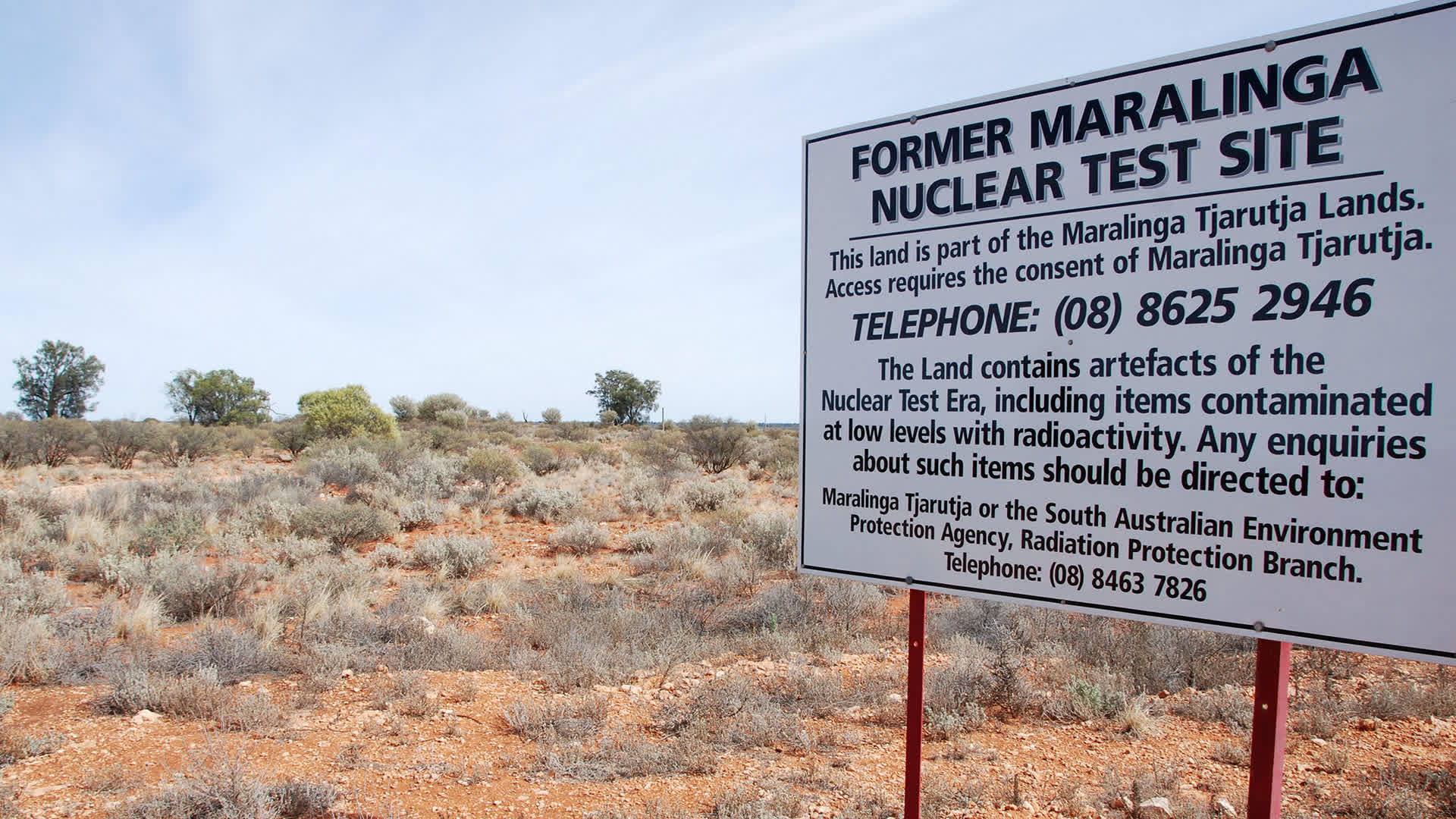
We were flown out to Australia, to a place called Maralinga. It's in the middle of a desert, nothing there but kangaroos and dingos.
Now in the balloon unit, we had barrage balloons that had to be raised into the air for parachutists to practice jumping off – that's how it started out.
Now, we were going out to Australia, but not for dropping parachutists – this time we were going to drop atom bombs…
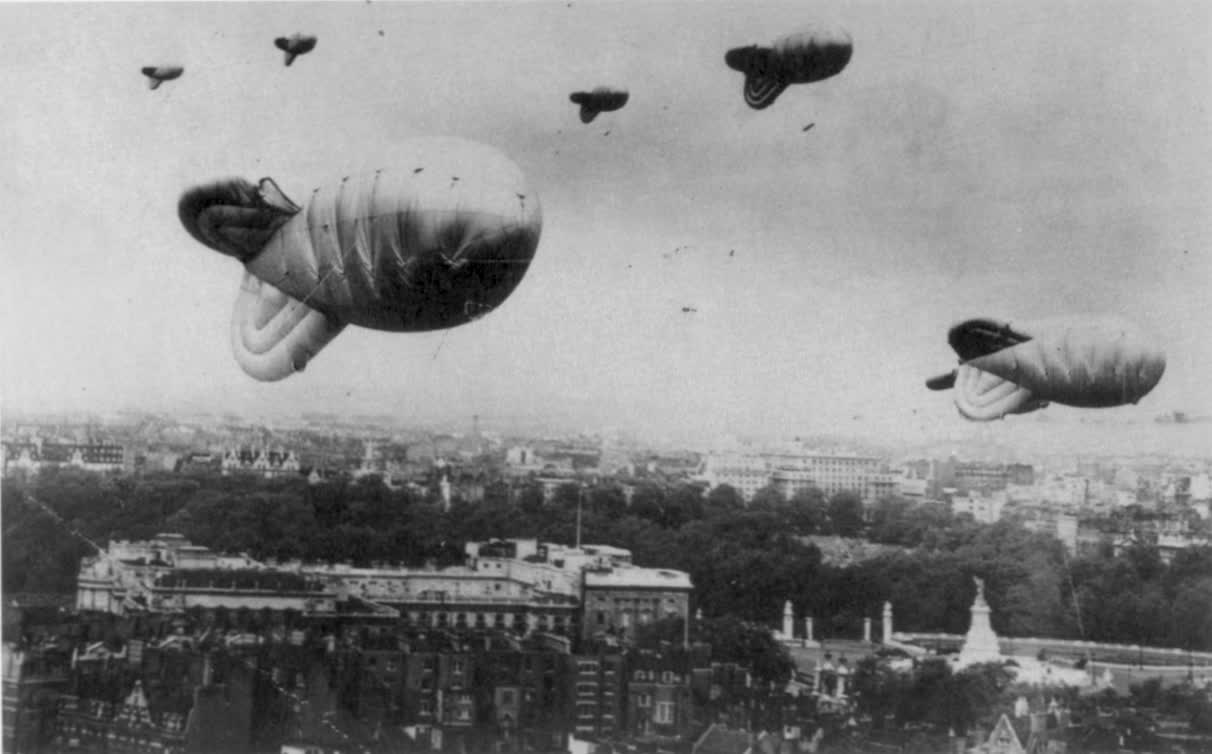
I happened to be the driver of the winch that released the balloon.
Underneath it we attached a basket, and in that basket we placed an atom bomb.
So I drove the winch. I’d let the balloon go up 800 feet, and then I had to run for my life to get to a safe place.
I drove about 6 miles away from the let off area – where’d I’d join the rest of my unit. And we were given orders.
We were to stand with our backs to where the bomb would go off, and these were the instructions we'd hear – "Three, two, one, flash, about turn."
"These are the instructions you're going to hear - Three, two, one, flash, about turn."
So, you knew roughly what was going to happen: it would go off, it would make a flash, but you shouldn't see that because it would blind you, and we were given very extra special sunglasses to protect us.
And that was our protection, by the way. We had no protective aprons, work clothes – nothing other than our ordinary clothes.
So the flash came. Then we were told to about turn and we could watch what went on. And what we saw was pretty frightening. I would never wish it on my worst enemies.
It was horrendous. This massive, great big mushroom of smoke in the air.
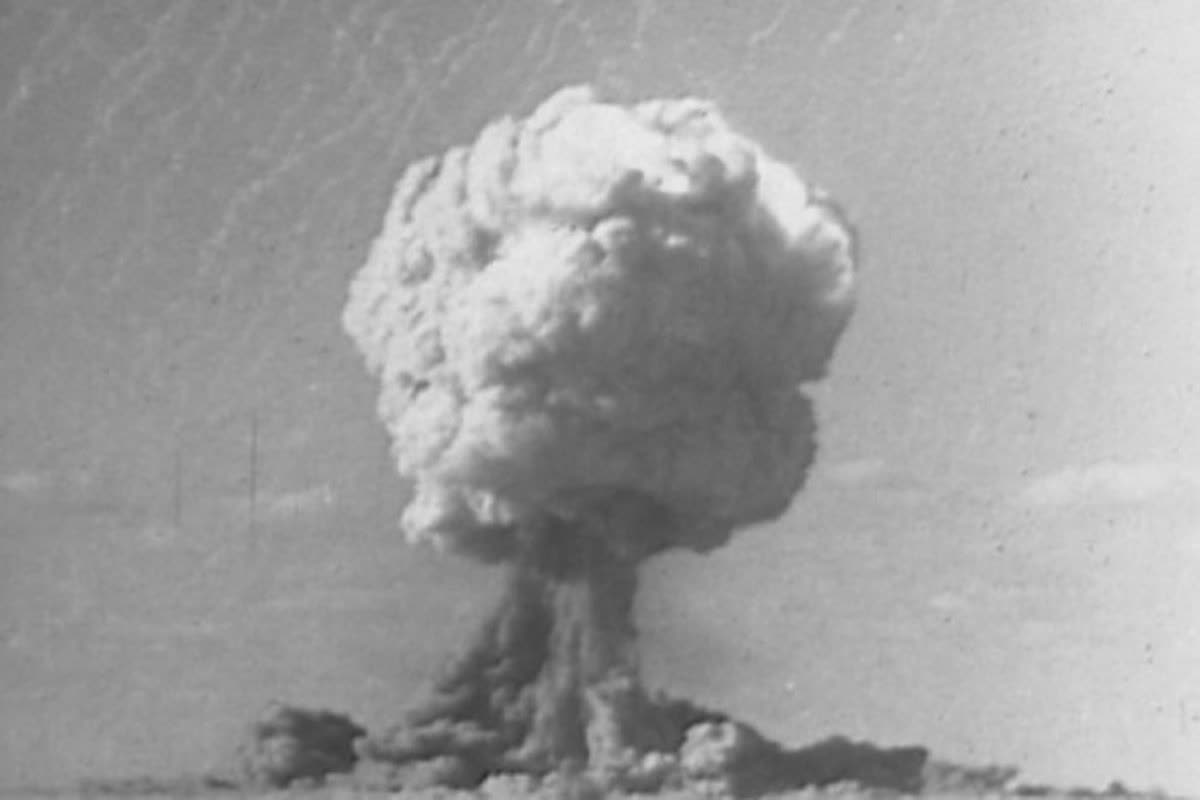
About a minute after we saw this thing forming in the sky, we saw all the little bushes on the ground quivering and shaking about.
And then we heard the most enormous bang. That was the bomb actually detonating. It was horrendous.
Now, this was the very first bomb we let off.
We were there to let off three bombs, the first one being the small one, second one, a medium one, but the third one, was to be exactly the same size as the Hiroshima bomb.
We carried on with our duties each day. We let off the second bomb.
That was all okay. And then we came to the third bomb, the Hiroshima-sized bomb.
Funnily enough, this was my birthday.
Once again, I was the driver of the winch. We put the bomb into the basket underneath the barrage balloon.
I don't know why we did it, but we all kissed the bomb before it went up.
"I don't know why we did it, but we all kissed the bomb before it went up."
Everything went fine at first. We waited for the countdown. We did exactly as we were told.
We were watching everything go on, and then all of a sudden a message came over the tannoy.
Something has gone wrong. This is an emergency."
The wind had changed and instead of blowing whichever way it should have been blowing, it's now blowing the exact opposite and the dust will now be blown over us.
"A message came over the tannoy. 'Something has gone wrong. This is an emergency."
We were told: "Do not try to rub the dust off you. Do not touch it with your hands."
We had no protective clothes, remember. We were not protected at all.
So the dust is blowing all over us. Then another message comes over the tannoy.
Stay where you are, do not do anything.
You will be taken to the sick bay where your clothes will be taken off you.
You will be put into showers, you will be thoroughly washed, and then you'll go to the sick bay.
And that is exactly what happened.
We went to the sick bay, and we stayed there for a month - because it took that long for them to clean us up and to get us, they thought, back to normal.
After the month we were released and told that because of what we'd done and what we'd been through, we'd have six weeks R&R in Adelaide to do 'whatever you like, when you like, where you like.'
And so we thought, 'oh, that's wonderful!' And off we went and enjoyed our six weeks in Adelaide.
A lot were taken ill there, very ill. Then when we came back, a lot of them passed away very quickly.
I had two very, very good friends. The three of us were like brothers.
I lost those two boys – just after we came home. It hurt.
And it's been with me ever since. I'm 89 now and it still burns me up exactly as it did then.
There were thousands of others who were being taken ill.
They were getting cancer, they were getting leukemia, and all other kinds of illnesses.
As of today, as of this very moment today, there are just under 1,200 of us left out of 22,000.
And I suppose, yes, we are the lucky ones.
I have a slight tick. My chin moves up and down at times.
That's all I received from all that radiation, so I'm very, very lucky.
Back at the unit, it was explained to us that what we did out there was a wonderful thing for the country.
We had helped to protect Britain from atomic attacks.
They had learned a lot from the three bombs and so we were very important people.
When you're in the services, you get a service medal.
No matter where you're posted to abroad, you get a service medal.
But we never received a service medal. Not until three years ago.
We were out there in 1957 and in 2023 we received a medal.
We had to wait 66 years for it. But eventually, we got it.
So three years ago, I received mine. But I didn't go to Buckingham Palace.
The King didn't present it. I didn't see a Prime Minister. I didn't see any minister.
Actually, all I saw was my postman.
"I didn't go to Buckingham Palace, I didn't see the Prime Minister… all I saw was my postman."
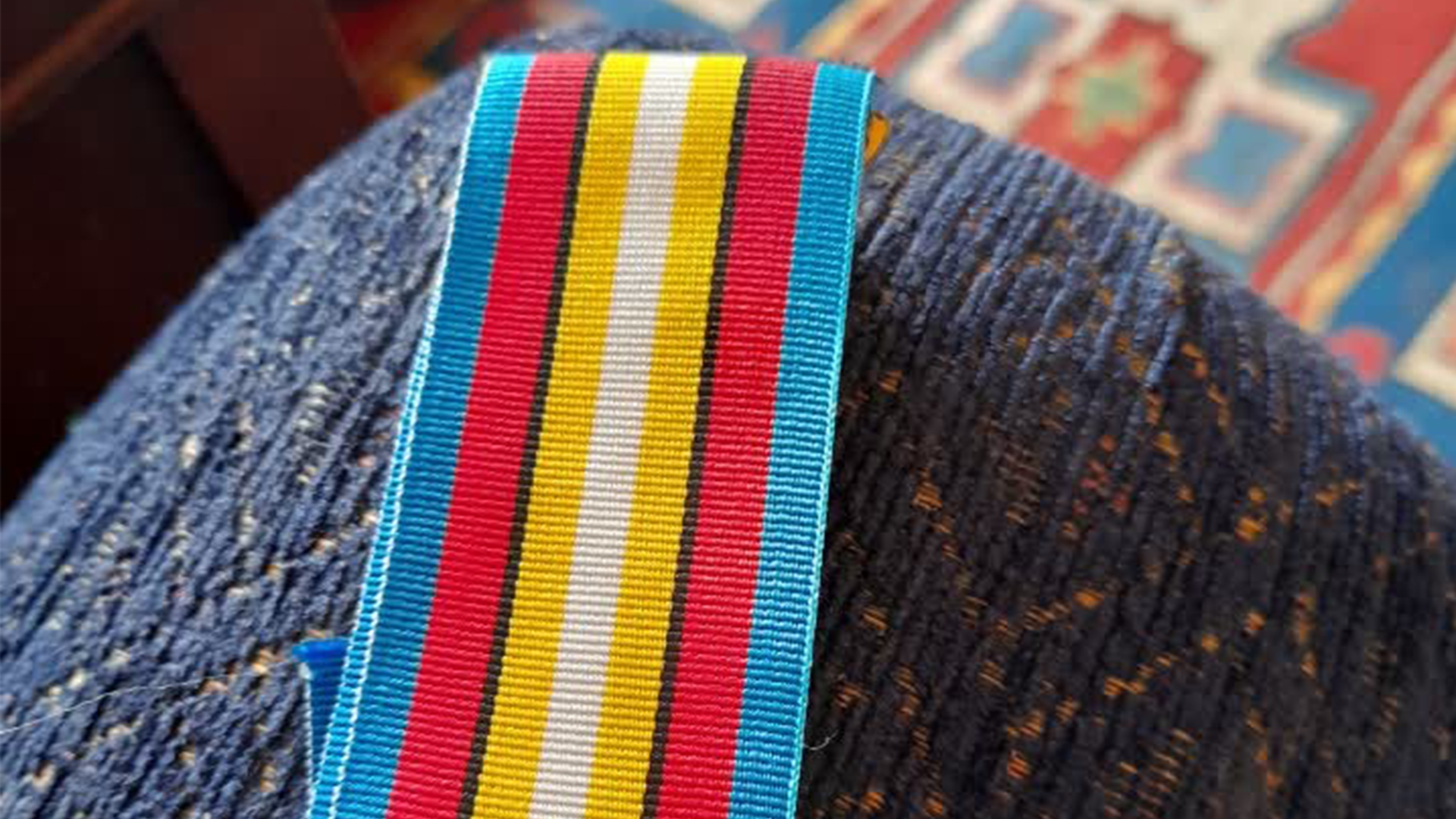
Because my medal, like everybody else's, was delivered by Royal Mail in a small cardboard box, put through the letterbox which dropped down on the
floor.
I picked it up, opened it, and there, lo and behold, "Thank you Brian, for all that you've done. Here is your medal."
Now a medal is a round silver coin with a sash and a fixing pin so that you can fix it to your lapel.
All we got was the medal on its own, the sash on its own, and no pin.
Now, what the hell are we supposed to do with that? It was a slap in the face.
So I took to Facebook. I got hundreds and hundreds of likes – people agreeing with me.
My local Royal British Legion got in touch. They said it was an absolute disgrace.
They collected the medal, put the pin on, put the sash and the backing on, so I would have a proper medal to wear.
And so I did. Three years ago – when I went to a remembrance service here in Epping.
I stood very, very proud with my medal on display.
And in fact, I will admit, I shed quite a few tears, because I've had to wait 66 years for this thing.
"I will admit, I shed quite a few tears, because I've had to wait 66 years for this thing."
It was the proudest moment of my life. And I've been wearing it wherever I go, whenever services are on, I wear my medal.
But the way the government treated us was terrible, and yet what we did for this country has protected it and made it a safe and wonderful place for every one of you out there to live in.
It was done by 22,000 people who actually didn't know what they were doing, but what they were doing was a very important job.
As far as the supposedly missing health records go, they took blood samples. From that day till this, I have never heard or seen anything about them.
But I know I had my blood taken. I know that for a fact.
So there you have my story up to date. I'm annoyed, I'm upset with the governments over time.
I think we've been treated in a disgraceful way.
But nevertheless, I'm here to tell the tale. And that is where I will rest my case.
Related topics
Join Our Newsletter