Ten-mile march, seven tests and a fight with a best friend: What it took to pass P Company

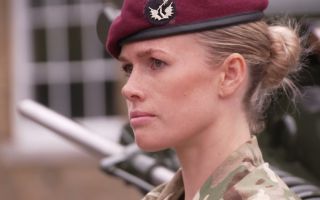
By the time Lance Corporal Grace Cussons reached the final test of P Company, she had completed loaded marches, raced with a log and stretcher, and tackled an obstacle course at height.
For the last event, she had to box her best friend.
"We were in the block the night before, literally listening to music, like drum and bass music, and staring each other in the face to try and get in the zone," she told BFBS Forces News.
- First female reservist to pass P Company says fallen friend inspired her to succeed
- Warrior women and their contribution to the military through the ages
- Gen Z women v Putin: The young women fighting Russia on Ukraine's frontline
The following day they faced each other in milling, a 60-second bout intended to test controlled aggression.
LCpl Cussons lost the fight, but passed the course, becoming the first woman in the Army Reserve to complete Pre-Parachute Selection.
Her friend, she said, came close but did not pass.
"I did actually lose. But the milling isn't about losing or winning your fight," LCpl Cussons said.

What does P Company demand?
LCpl Cussons said she had encountered suggestions that the course had been made easier because she was a woman.
Women and men taking the same selection course face the same tests, loads and time limits.
The differences are between the Reserve and Regular courses.
"There's been a lot of press out there about whether the course is different and that has enabled a woman to pass. It's not, it's identical," she said.
Reservists face seven events. In the 10-mile loaded march, they carry a 35lb bergen, a weapon and a litre of water.
Its purpose is to test how quickly soldiers can move from a parachute drop zone to a rally point.
The loaded two-mile march tests another rapid movement under the same load, with a helmet added.
At the trainasium, candidates must follow instructions while negotiating an aerial obstacle course.
They also carry a log 1.9 miles as a team, in a test linked to resupply, and a stretcher five miles to simulate evacuating a casualty.
Neither team race has a fixed finishing time, although candidates aim for under 20 minutes on the log race and under 50 on the stretcher race.
A steeplechase and the milling bout complete the reservist tests.
How do the Reserve and Regular standards differ?
While women and men have the same requirements, the tests differ for reservists and regulars.
:: Ten-mile loaded march: Reservists have two hours; Regulars have one hour 50 minutes.
:: Steeplechase: Reservists have 20 minutes; Regulars have 19 minutes.
:: Loaded two-mile march: Reservists have 19 minutes; Regulars have 18 minutes.
:: 20-mile loaded march: Regulars must complete it in four hours 30 minutes. Reservists do not undertake it.
The trainasium, log race, stretcher race and milling feature in both courses.
Coming back after failure
LCpl Cussons passed on her second attempt, much to her own disbelief at first.
"I failed the first time, learning that I wasn't fit enough, and came back and managed to pass," she said.
For her second attempt, she worked with Farren Morgan, a former Coldstream Guards soldier who trains people for arduous courses.
She said running alone had not prepared her for the demands of carrying weight through the week.
"I quickly learned that I needed to get in the gym, do a lot more lower body strength," she said.
After a year of training, LCpl Cussons found out she had passed when her number was called on the parade square. "I was still expecting to hear the fail and be marched off the parade square," she said.
Passing P Company earned her the coveted maroon beret.
The Basic Parachute Course, where candidates train to earn their parachutist wings, is a separate next stage.
"We have such a massive job to do of getting more women through arduous courses," LCpl Cussons said.
Join Our Newsletter