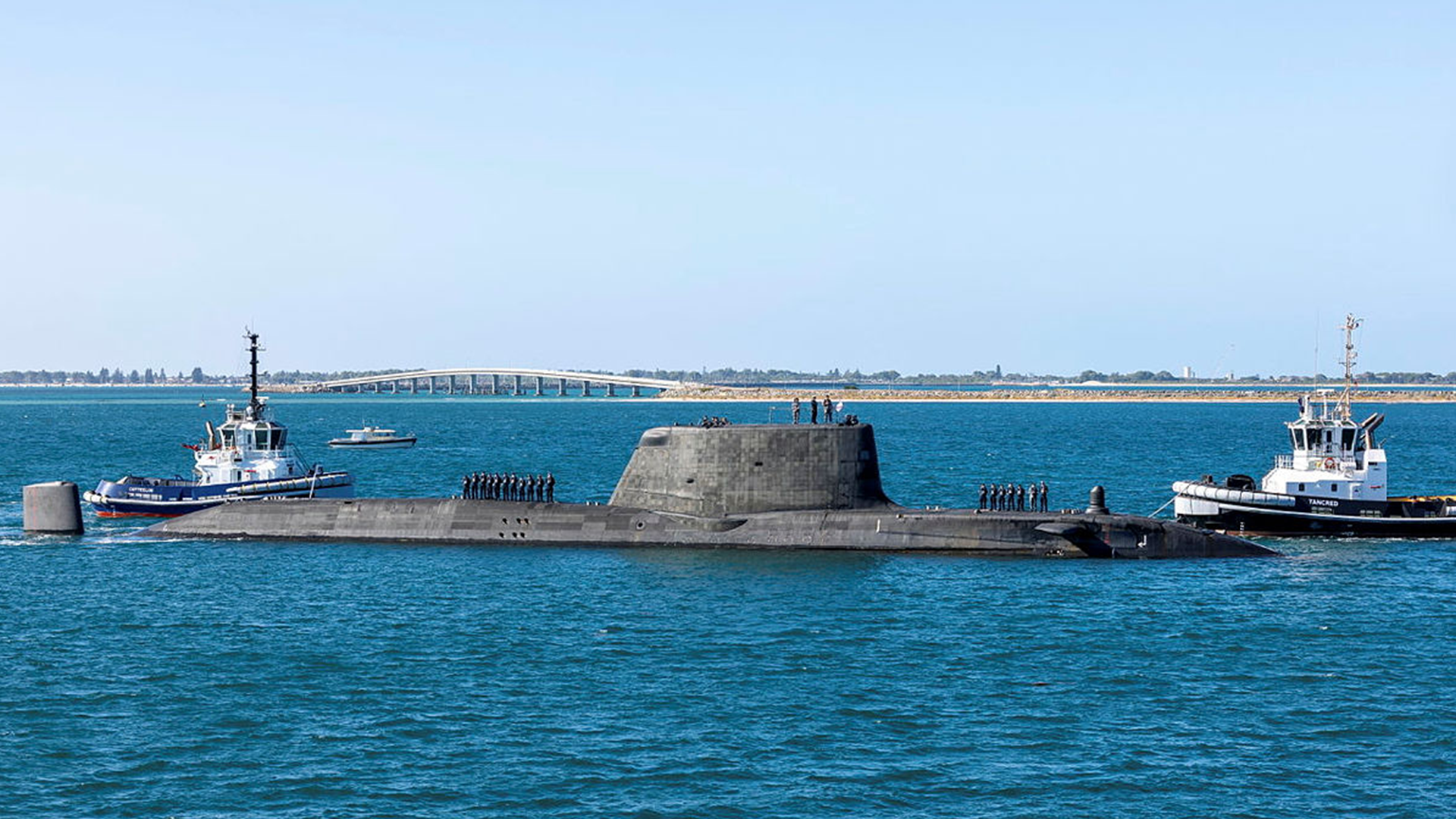
With the Chief of Defence staff warning that the UK is in "the most dangerous period" in decades, reports that all five of the UK's Astute-class nuclear-powered attack submarines (SSNs) are currently docked and undergoing maintenance have added to growing concerns surrounding the Royal Navy's readiness.
Speaking to BFBS Forces News, former nuclear submarine captain Ryan Ramsey said that while it deprives the UK of a vital capability, the problem runs deeper.
"This is about defence infrastructure, this is about government, this is about industry, and this is about the nation as a whole making sure that we come together quickly, rapidly, and rectify this situation to restore our submarine capability," Commander (Ret'd) Ramsey said.
Troubled waters
Equipped with Tomahawk land attack missiles and Spearfish torpedoes, the Astute-class play a key role in protecting the UK's fleet of Vanguard submarines, which carry Trident nuclear missiles. Alongside that, they also support other naval assets, including the carrier strike group.
Having the entire fleet docked simultaneously means the UK can no longer operate worldwide or maintain a continuous presence in areas such as the North Atlantic, Cdr Ramsey explained, adding the only way to mitigate this is to use towed-array frigates and the P-8 maritime patrol aircraft, "of which we have few".
A report by the Mail also claimed that military experts fear this will also leave the UK's undersea internet and power cables more vulnerable to Russia's hybrid warfare attacks.
While Cdr Ramsey acknowledged this vulnerability, he said that as a member of Nato, some of that capability will be provided by other submarine-operating nations – such as the US – while the maintenance period is finished.
Nonetheless, although maintenance issues were "inevitable", Cdr Ramsey argued they were merely a symptom of a much larger problem.
"The presumptions way back when, when they decided that a solely nuclear fleet of only seven attack submarines and four ballistic missile submarines was going to be sufficient to keep us as a world-leading anti-submarine warfare player, were probably the wrong assumptions," he said.
He added: "You need lots of units to be able to do this. Underwater autonomous vehicles may be one way to overcome this, but in the near term, that might not be the answer."
Difficult decisions
All of this falls under the submarine maintenance recovery plan, a 100-day directive ordered by the First Sea Lord, General Sir Gwyn Jenkins, to address the chronic maintenance delays with the submarine fleet to ensure war-fighting readiness.
"This decision will not have been his [the First Sea Lord] and will not have been taken lightly," Cdr Ramsey said, adding that "he probably had little choice".
For the former nuclear submarine captain, who commanded the Trafalgar-class HMS Turbulent during his 23-year tenure in the Royal Navy, maintenance work of this nature is not unprecedented, though there are significant caveats.
"In the late 1990s, all submarines went alongside for a particular defect that had been found and needed to be rectified. I think there was one submarine at sea then," he said.
"And in 2011, when I was in command, at one point we were the only SSN at sea whilst everybody else was going through maintenance.
"So this is not unprecedented, but it's unprecedented in the fact that the number of submarines we have available to us now is so low, and the context is that Russia is increasing its activity and the world is less safe than it's ever been."
He added that the limiting factor here is the infrastructure to support the maintenance work.
"There are only so many dry docks available... there's limited availability of personnel with the skills needed to carry out the maintenance, and there are limited simulators to make sure that people are ready to go.
"Because all of the submarines need to undergo all of this maintenance, it's going to put a huge load on all of those organisations to achieve it," he said.
Protection guaranteed
The MOD said it did not routinely comment about specific submarine operations and availability but insisted British waters were "always protected with a range of assets including warships, patrol aircraft and submarines".
A spokesman added: "Strengthening and sustaining our submarine capability is a top priority, and we are taking decisive action to ensure its long-term resilience."
Join Our Newsletter