Replacing the Red Arrows' jet: What could follow the outgoing iconic Hawk?
A jet replacement hunt is on.
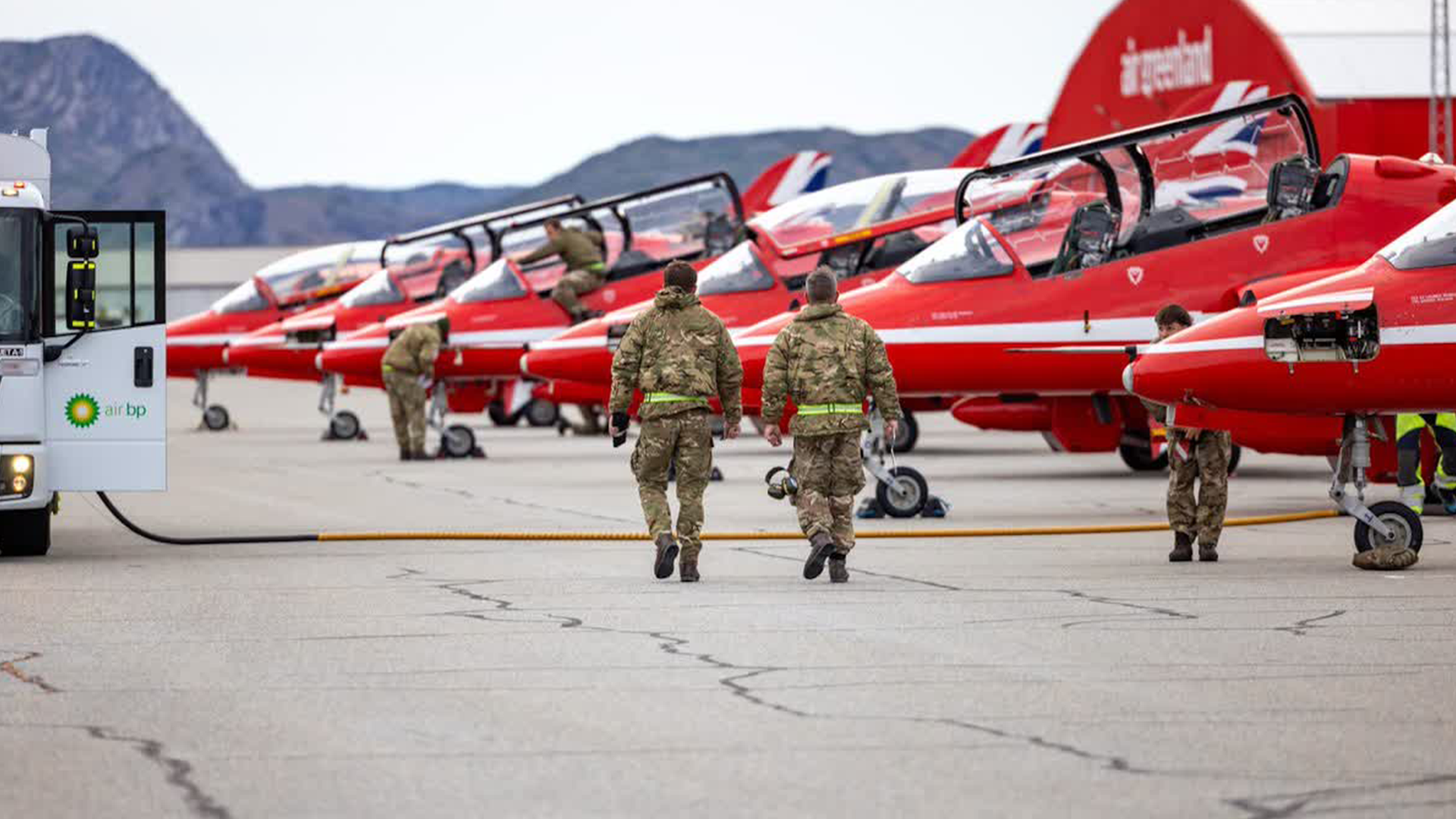
The Red Arrows display team's Hawk T1s are out of service in 2030, and the RAF needs to swap out its 28 less manoeuvrable Hawk T2s used to train pilots.
The Government says £860 million will maintain the safe operation of both platforms until the arrival of the 'Jet Training System' – delivering a cost-effective aircraft that can perform both roles.
- Red Arrows finally cross Atlantic after weather left them stranded in Canada
- Swapping Arrows for Barrows: Team set to replace the Reds after cancelled UK displays
- Who is in the race to replace the Red Arrows' Hawk T1 with a new next-generation jet
Meanwhile, the UK is committed £360 million to replace the Hawk T1 and T2 fleets.
While not all of the following have confirmed they'll compete for the spot, we've picked out some platforms that could be of interest to the MOD.
:: The T-7, BAE Systems, Boeing, Saab
British manufacturing giant BAE delivered the Hawk in the first place, while Boeing and Saab are already behind the T-7A Red Hawk – a US-Swedish transonic jet selected by the US Air Force in 2018 as a pilot training system.
With sovereignty fast becoming a focus for prospective British military equipment, it's understood the platform would be based on the Red Hawk but that the increased involvement of Britain in the aircraft supply chain will be explored – with final assembly set for the UK.
The T-7A Red Hawk has a twin tail fin configuration at the top speed of approximately Mach 1.
Only a handful have been built so far, but the US wants hundreds of them.
As well as flying, the T-7 system will also offer simulation training for those looking to pilot the Typhoon, F-35s and future aircraft such as the sixth-generation Tempest.
:: M-346, Leonardo
This twin-engine jet is already used by Italy, Israel, Poland, Singapore and soon Indonesia – with more than 100 already built.
The M-346 uses a fly-by-wire system specifically designed for trainee pilots, with various limits placed on performance including the amount of g-force they're exposed to.
Italy's Leonardo is open to a greater UK footprint in the manufacturing process if it were to provide a solution to the UK's Hawk challenge.
Originally developed with the Russians, who fly their own version, the aircraft is used already by the Italian aerobatic display team.
:: T-50 Golden Eagle, Korea Aerospace Industries and Lockheed Martin
The Golden Eagle is already operated or ordered by South Korea, Indonesia, the Philippines, Iraq, Thailand, Poland, and Malaysia.
In production since 2005 and with more than 200 already built, the mature platform is able to go supersonic.
A multi-role jet, it takes on varied duties as a jet trainer, light combat aircraft and even light air superiority fighter.
While its roots don't lie in the UK, the T-50 is capable of Mach 1.5 and is used by the South Korean Black Eagle's aerobatic team.
:: Hürjet, Turkish Aerospace Industries
Another aircraft capable of supersonic flight, TAI's Hürjet presents a different option for the UK.
Still in development, it's a light combat as well as a trainer aircraft – chosen by Spain ahead of the three platforms mentioned above to replace its Freedom Fighter jet trainers.
Again, there's less obvious routes here to UK manufacturing, but there's already been cause for celebration within the programme.
This aircraft has already been ordered by the Spanish Air Force with deliveries expected to begin in 2028.
:: Freedom, Sierra Nevada Corporation
Developed by SNC alongside partners like Northrop Grumman and General Atomics, Freedom will compete for the role as the US Navy's undergraduate jet trainer – and potentially the UK's Hawk replacement.
Described as a clean-sheet, twin-engine jet, it's still early days for the concept and the platform may potentially exist purely as a Top Gun aircraft – SNC putting a lot of emphasis on its carrier-landing capability.
However, low operating costs and augmented reality integration are also detailed under the Freedom – the performance of the plane reportedly representative of 4th- and 5th-generation aircraft.
Related topics
Join Our Newsletter