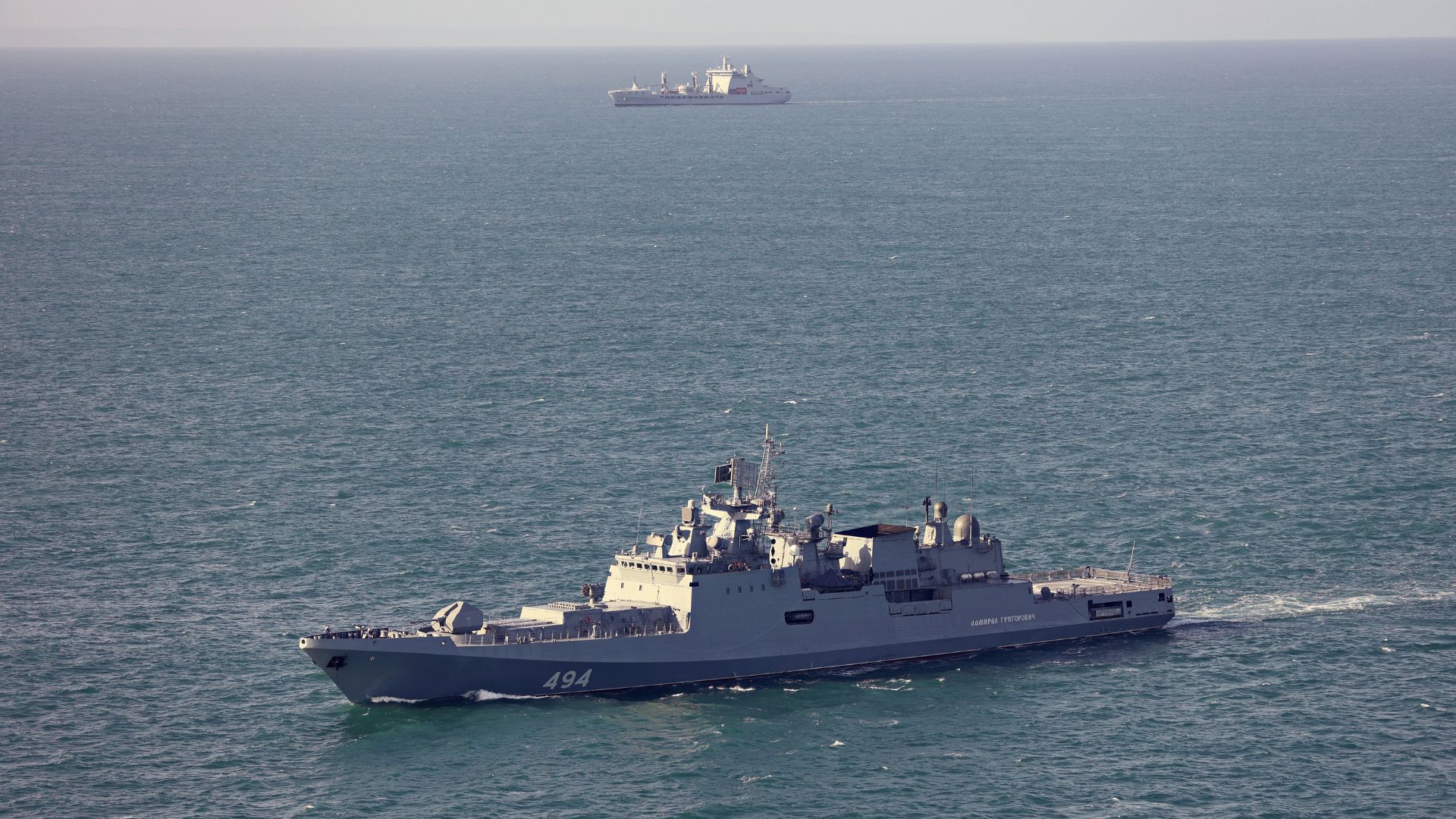
At around 11:40am on Tuesday, a British couple sailing their 40ft yacht in the English Channel found themselves in close proximity to a Russian warship, which fired warning shots in their direction.
There were no injuries, and the yacht was not damaged in the incident, which is understood to have involved the Russian frigate Admiral Grigorovich about 20 nautical miles south of the Isle of Wight, outside the UK's territorial waters.
Despite initial fears of Russian aggression, the Ministry of Defence has said the shots were not aimed at the vessel and were an attempt to prevent a possible collision.
It comes just days after Royal Marines boarded the Russian shadow fleet vessel Smyrtos, and while the Ministry of Defence announced that the two events are unrelated, Commodore (Ret'd) Steve Prest said the timing strikes him as more than a coincidence.
"I think the messaging here is really about the Russian navy, by extension the Russian state, baring its teeth in the channel very gently, but just really saying 'we are here and we are prepared to stand our ground when we need to'," Cdre Prest told Good Morning Britain.
According to the Russian defence ministry, the yacht had been on a "dangerous approach", and the warning shots were fired after attempting to draw the attention of the yacht's crew through signal flares and sound signals.
More significantly, it said Russian sailors had acted in strict accordance with international shipping regulations.
The law of the sea
While not prohibited under the United Nations Convention on the Law of the Sea (UNCLOS) – the legal framework governing activity in the world's oceans – warning shots are admissible as a last resort.
Nevertheless, vessels must exhaust all other non-violent means, including radio calls, visual signals, and flashing lights.
Speaking to BBC Newsnight, the retired couple, Jane and Alan Kelvey, disputed Moscow's claims, insisting they were not on a dangerous course.
"They did not send up flares; they did not radio us," Ms Kelvey said. "There was absolutely no problem as far as we were concerned; we were just going to go sailing straight past them."
Ms Kelvey added: "They're blaming us, and as far as we're concerned, we were blameless."
Blurring the line between peace and war
Speaking to BFBS Forces News, Basil Germond, Professor of International Security at Lancaster University, said the incident could indicate a sense of nervousness from Russia.
"Moscow wants to stress that it has not lost its ability to operate in our backyard and is ready to test the UK's boundaries by engaging in plausible deniable activities in the maritime grey zone," he said.
Grey zone tactics blur the line between peace and war, and can serve as a precursor to conventional armed conflict.
Prof Germond added that it could also indicate Russian Navy's rules of engagement have loosened, in order to enable more "determined activities" in international waters in response to recent boarding incidents by the UK, France and the US.
"These actions would still be legal but more assertive and at the boundary between what is acceptable or not in peacetime," he said.
As Prime Minister Keir Starmer announces new sanctions targeting Putin's war machine at the G7 summit in Paris, attention will turn to Downing Street over how it intends to respond to the emerging threat.
Join Our Newsletter