Hybrid hallelujah: BFBS man comes out in favour of new high-pressure ammo
I need to state this from the outset. I am not against the 5.56 Nato round.
My rifle during military service in South Africa was the R4, a copy of the Israeli Galil, and chambered in 5.56x45mm.
I remember it for its AK-style reliability, great accuracy at distances out to 300 metres and being nice and controllable when fired – very rarely – on automatic.
Loving light weight
It was, however, heavy at 4.3kg and the cut-down R5 version issued for security duties wasn't much lighter – so lugging it for four hours on guard duty is not an experience I miss.
My first inkling that things could be better came when I fired a US Army M4 carbine during a shooting experience in Prague – offering the same controllable burst, but in a much lighter package.
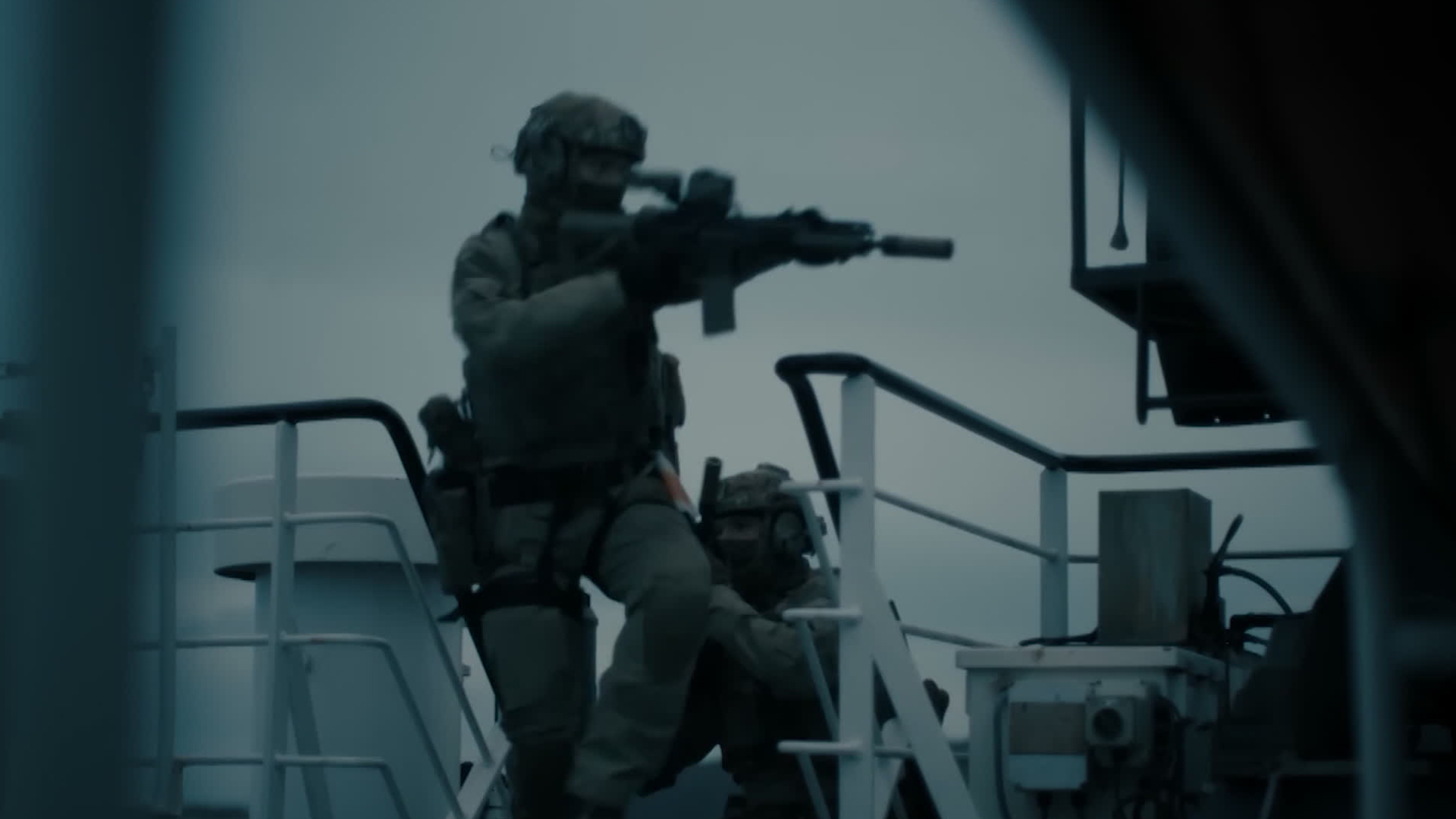
Fast-forward to a range in New Hampshire and I got my hands on an AR-style rifle as ordered by the Royal Marines – the SIG Sauer MCX.
The ergonomics are great, with all controls in easy reach in a compact package with a 13.5" barrel.
Unlike the rifle I fired in Prague, this is a piston-driven system.
Gas hits a small piston to work the action and does not enter the rifle's body to drive the bolt group – and it has an easily reached valve at the front of the rifle to increase gas flow in adverse conditions.
The forward assist control is not present on this gun, at the request of the Royal Marines, but the standard T-piece cocking handle and selector levers are easily accessible by either hand.
The trigger was crisp and the reticle in the optic was clear and easy to keep on target. I have proudly kept the target to show where I kept a tight grouping in the headshot area – my record with red dot type sights on civilian ranges is not great.
The Royal Marines also use the same rifle in .300 Blackout, a subsonic cartridge that retains the necessary knockdown power whilst being easily suppressed.
It was equally well behaved – I was having a good day! And then it got better.
Shooting M and Ms
First the M7 – the US Army service rifle that's slowly being replaced by the M8. Same ergonomics, improved by the addition of a left-side charging handle and an encounter with the hybrid 6.8x51 Common Cartridge.
Yes, you must hold it tight – it pushes more than 5.56, but it does not push as much as the bolt-action 7.62 P14 rifle I once owned, or my semi-auto shotgun – and the LVPO mounted on it was very easy to see and adjust.
The new kid on the block was equally impressive – the M8. Same power in a compact rifle with a 13.5in barrel weighing just 3.9 kilos.
Now yes, it is not as easy to shoot as a similarly sized 5.56 platform, but I am an older civilian shooter (who skips leg day and every other day at the gym) and I found it completely manageable, as did my leftie colleague Sian, so fit young service personnel should adapt to it quite quickly.
The M8 is being issued with 25-round magazines, but the ones we used were 20-rounders and, of course, the rounds weigh more than 5.56 – mags coming in at 567g fully loaded.
But that compares quite favourably with steel SLR magazines, which come in at about 726g – and many British Army veterans won't hear a word said against that weapon – mostly because of the powerful 7.62mm round.
As I scrambled on the ground for empty cases to keep as souvenirs, the power of the cartridge was the main impression I took away – and from a small customisable platform complete with a suppressor.

It's all about the ammo
The suppressor is interesting in its own right. Put your hand round a regular suppressor on an empty just-fired rifle and the searing heat is easily felt, but there was almost no radiant heat felt from the side of this one – thanks to an impressive piece of heat-shielding technology.
Now confession time: I have never fired an SA80, but I have tried its trigger on an Army Development Day, and I would say that the mushiness of a long transfer bar was obvious to me – a problem common to most bullpup designs.
That design was chosen because it allowed a full-length rifle barrel in a compact package, thus retaining velocity.
SIG Sauer's approach to the new velocity challenge is a hybrid steel and brass cartridge case that can take chamber pressures of around 85,000psi, delivering a bullet that can defeat Nato Level 4 body armour.
The trade-off comes in terms of the weight of the rounds, smaller magazine capacities and more recoil.
And while the US Army has accepted these it remains to be seen whether the MOD will consider it the right bang for its buck.

Related topics
Join Our Newsletter