First look at US Army's M8 as SIG Sauer showcases potential replacements for SA80

There's a rifle race going on right now as several companies are eyeing up the MOD's plans to replace its main service rifle, the SA80.
BFBS Forces News was given special behind-the-scenes access to one of the companies preparing to join the race once the MOD officially fires the starting gun.
We travelled to New Hampshire in the United States to SIG Sauer to test out some of the rifles it might throw into the mix for Project Grayburn, the MOD's programme to replace the SA80.

A rifle for the next 40 years
We fired the company's M8, M7, the Royal Marines' MCX variant, the 516 G3 and the MCX LT 300 Blackout.
The MOD's decision will affect personnel for decades to come.
Adam Agri, SIG Sauer's Director, Technical Sales and Support, said: "Grayburn is really exciting because the UK is going to define the next weapons system that will be with the UK soldier for the next 40 years."
The SA80 family of weapons was originally introduced back in the 1980s, SA80 standing for "Small Arms for the 1980s".
Mr Agri told us: "I don't think the SA80 is a bad system. It's just older. And at the time, it was cutting edge. It's probably twice the weight of an M16, so we can cut the weight down, even with the higher calibre systems than what you would have with your SA80."
Right now, according to the latest figures from the MOD, there are more than 166,000 SA80 variants in use across all of the services.
Personnel tell me they want a rifle that is lightweight, that's easy to clean, that's adaptable and can be used by left-handed shooters – something the SA80 cannot.

The US Next Generation Squad Weapon
To appreciate the M8, the US Army's Next Generation Squad Weapon, we first need to take a look at its predecessor in the NGSW programme, the M7.
Mr Agri explained: "This weapon system [the M7] came from requirements from the government. They said 'take this projectile, make it go this fast'. 'You have a box that you can fit the gun in, and it can only weigh this much'.
"It was very loose requirements. Many companies put in for that tender and they all did it differently.
"SIG went the most traditional route. To get that velocity, what we did was we made a hybrid-style case system. What that means is I can have a stronger case base that allows me to increase the velocity using the case, not increase the velocity using barrel length."

Hybrid case tech explained
He added: "With that hybrid case technology, you have to make the weapon significantly more robust to handle that increase in velocity, which the M4 doesn't have.
"So all of the things on the M4 that would wear out, we've reinforced with steel."
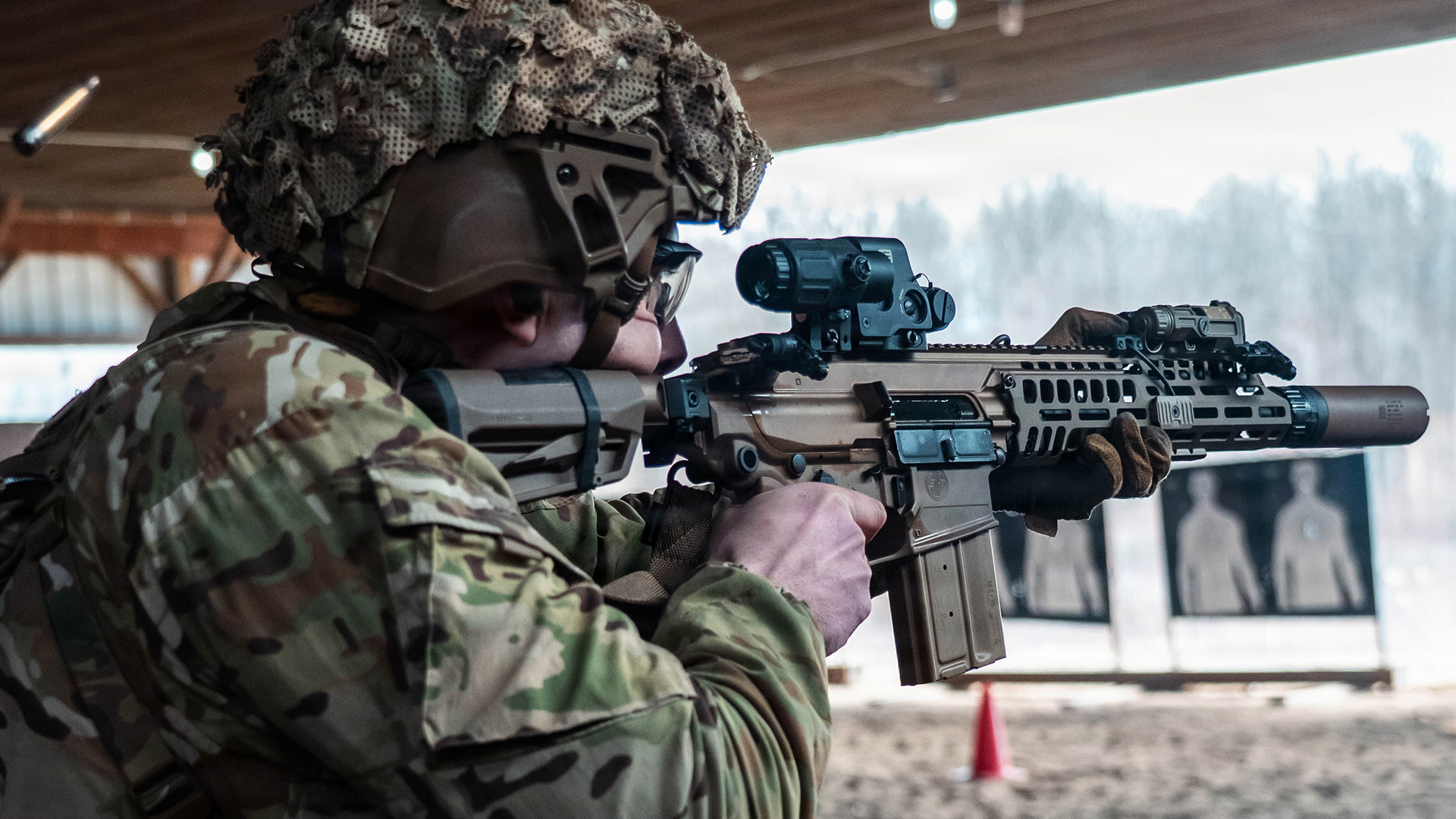
It's configured with SIG's SLX suppressor and a Tango 6T 1-6x variable optic on top.
"It's very flexible," Mr Agri said of the sight. "So I can use it for close-range shooting at one power and anything up to six power.
"It's not intended to be a sniper optic, but it gives you the ability to identify targets at further ranges and engage targets at further ranges than you would traditionally get with iron sights or a red dot system."
He added: "This particular rifle has a 13" barrel and we have 20-round magazines with it. We are coming out with 25-round magazines."

The evolution from M7 to M8
Josh Shoemaker, SIG's defence product manager for rifles & suppressors, said: "This was the biggest programme with the most amount of soldier input that I've ever been a part of.
"It was almost a weekly basis [where] we were at some military base getting feedback from soldiers about what they liked, what they didn't like, and we were constantly feeding that back to our engineering team here to make adjustments.
"As that rifle gets fielded across a broader array of soldiers, you get more feedback and I think most companies probably would have hung their hat up on the hook, called it a day's work after they were awarded [but] the evolution of the M7 was heavily influenced by soldier feedback."
So what's the difference between the M7 and the M8 which is now replacing the M7 for the US Army?
Mr Shoemaker explained: "[The M8] now gives you a weapon system that's extremely lightweight. It's shorter, it's more manoeuvrable. I think when you look at it compared to their [the US Army's] legacy M4 rifle, we're only a pound heavier, but with a far greater reach and capability."
Mr Agri added: "The M8 is the shorter version of the M7, it's lighter and more compact, so keeping lethality is up, but having a more manoeuvrable, more compact, weapon system that was the goal with this.
"The controls are identical between the M7 and the M8, you just have a shorter barrel, a lighter hand guard.
"We changed the barrel profile so it's slightly lighter, and the upper receiver is lighter and a non-folding stock, but essentially shooting one to the other, there's no training burden to the operator."

Everything's a trade-off
At the moment the MOD is in the concept phase of Project Grayburn. It's still deciding what the elements will be, but has given us some clues about what it wants.
The MOD has said it's looking for something that will provide sufficient lethality to defeat current and emerging body armour and something that has signature reduction technology on some variants.
It also wants Project Grayburn kit to be manufactured in the UK.
Mr Agri said: "There's not one thing that can do everything well. We have to target specific requirements.
"In the case of Grayburn, once we have that requirement we can target it, but I think what has to happen is the MOD has to understand what are those requirements? What are we trying to achieve with this new system?
"Is it just a new rifle that shoots the same stuff – or is it increasing lethality, increasing capability? And that's where we think we have a better mousetrap."
Hybrid ammunition
With the US Army moving away from Nato's 5.56x45mm round to 6.8x51mm hybrid ammunition, there is a big question mark over whether the alliance will follow suit.
Will the requirements for Project Grayburn include a move to hybrid ammunition? If so, what sort of an edge does it give soldiers?
Mr Agri described what it means to the shooter, saying: "My bullets are coming out faster and they are more lethal."
Kevin Sipes, SIG Sauer's Special Projects and Ammunition Product Manager, explained why he thinks militaries need to be using hybrid ammunition.
"Coming from my background and multiple combat deployments, it's something I wish that I had," he said. "Hybrid capability has been shown to defeat different levels of armour.
"I'm better able to psychologically affect their will to fight. Do you still want to fight me when I'm engaging you with a hybrid capability?"

How fast could Grayburn be delivered?
Some 40% of SIG's workforce are veterans, so defence is in their DNA. We were given a rare chance to tour two of their vast factories in New Hampshire.
One of them has striking black tubes high up towards the ceiling – they are shooting ranges installed above assembly lines.
Jack Guillemette, Manager, SIG Sauer Firearms Assembly, remarked as he took us around: "I've never worked in another building where you're shooting over your head and you're building guns underneath it – it's pretty wild stuff."
Seeing the vast manufacturing operation up close, we wanted to know how long it would take in the unlikely event that the full order was put in tomorrow.
Dave Buehler, Vice President of Manufacturing, told us: "A good way to look at that would be okay, 10,000 rifles a month.
"Capacity here in Rochester is available for 30,000 rifles a month. We're currently only running at a pace of 12 to 15, with aspirations to get to 18.
"That isn't driven by capacity, it's driven by demand. So if we were able to load in additional demand, we have the capacity available.
"We do have to define the requirements though - and the devil is in the detail there."

UK production
The MOD has said it wants Project Grayburn to enhance sovereign supply chains, generate employment and provide a platform for exports, but what does that actually mean in practice?
Is that fully manufactured in the UK? We don't know the answer to that yet. So is SIG willing to manufacture in the UK?
Former Royal Marines reservist Duncan Stewart, SIG's UK Director, said: "SIG Sauer is busy looking at options for what our offer for UK sovereign manufacturing could be.
"Really I think the MOD could help industry focus their activity at the moment by being more specific about what they want both in terms of sovereignty and technical requirements."
The spotlight is firmly on the MOD when it comes to its procurement processes across the board. Will it continue to do things the way they've always been done or is this project an opportunity to speed things up? And what's the cost if it doesn't?
According to information released by the MOD so far, the estimated start date of the contract is 2028 and to be delivered over the course of 17 years.
That's despite Defence Readiness & Industry Minister Luke Pollard telling industry representatives at DSEI last year: "We need to speed up our contracting and decision-making.
"Procurements that take five years need to take two years. Those that take two need to take one. Those that need to take six, need to go to two to three months.
"Now, that is not just a target from the Strategic Defence Review. That is a mandate for culture change."

It's going to be more dangerous
Mr Buehler said: "So you asked me a question: is the battlefield more dangerous today than 10 or 15 years ago? If we don't change how we develop and procure solutions for our service members?
"The answer is yes it's going to be more dangerous. SIG Sauer would like to solve that problem."
"Does it all come down to speed?" I replied. "It does," he said. "Speed and agility absolutely."
For now the precise details for Project Grayburn remain behind closed doors, but what we do know is that some personnel might still be using the SA80 well into the 2040s.
Related topics
Join Our Newsletter