Russia's jet-powered drones raise stakes as Ukraine races to counter dangerous aerial threat
The sound of Russia's air war against Ukraine is changing.
In just two-and-a-half years, Moscow has gone from experimenting with jet-powered attack drones to reportedly producing thousands every month.
These new weapons are faster, harder to intercept and increasingly resemble cruise missiles rather than traditional drones.
- Homegrown and feared by Russians: Inside Ukraine's 'silent death' robot units
- Nyan: Inside the British jet-powered strike drone at the centre of Russia's threat to UK
- Alchemist: The Ukrainian who tricks Russian missiles into thinking they're flying over Peru
As Ukraine braces for another winter of Russian attacks, the combination of jet-powered drones, ballistic missiles and cruise missiles presents a growing challenge.
So, what are these new drones, how has Russia scaled up production so quickly, and what can Ukraine do to stop them?
Russia's first jet-powered attack drones appeared in late 2023.
Based on Iran's Shahed-238, they were renamed the Geran-3 and were a significant upgrade over the propeller-driven Geran-2.
With a range of around 1,200 miles and a cruising speed of roughly 200 miles per hour, these drones could travel deep into Ukrainian territory.
But Ukrainian air defences could still catch them.
That began to change last year, when Russia started developing two new models: the Geran-4 and Geran-5.
By January, they were being used against Ukrainian cities, and the impact was immediate.
Ukraine's claimed interception rate against older Shahed drones had reached around 90%.
Against the newer threats, that figure has reportedly fallen below 60%.
Meanwhile, the scale of the attacks has increased dramatically.
Drone strikes reportedly rose eightfold between June and August, approaching 3,000.
The attacks have also become more relentless, combining larger numbers of drones with ballistic and cruise missiles.
Civilian infrastructure, schools, petrol stations and vital transport links have all come under attack.
The result is a much less predictable campaign, designed to stretch Ukrainian air defences and inflict damage across a wider area.
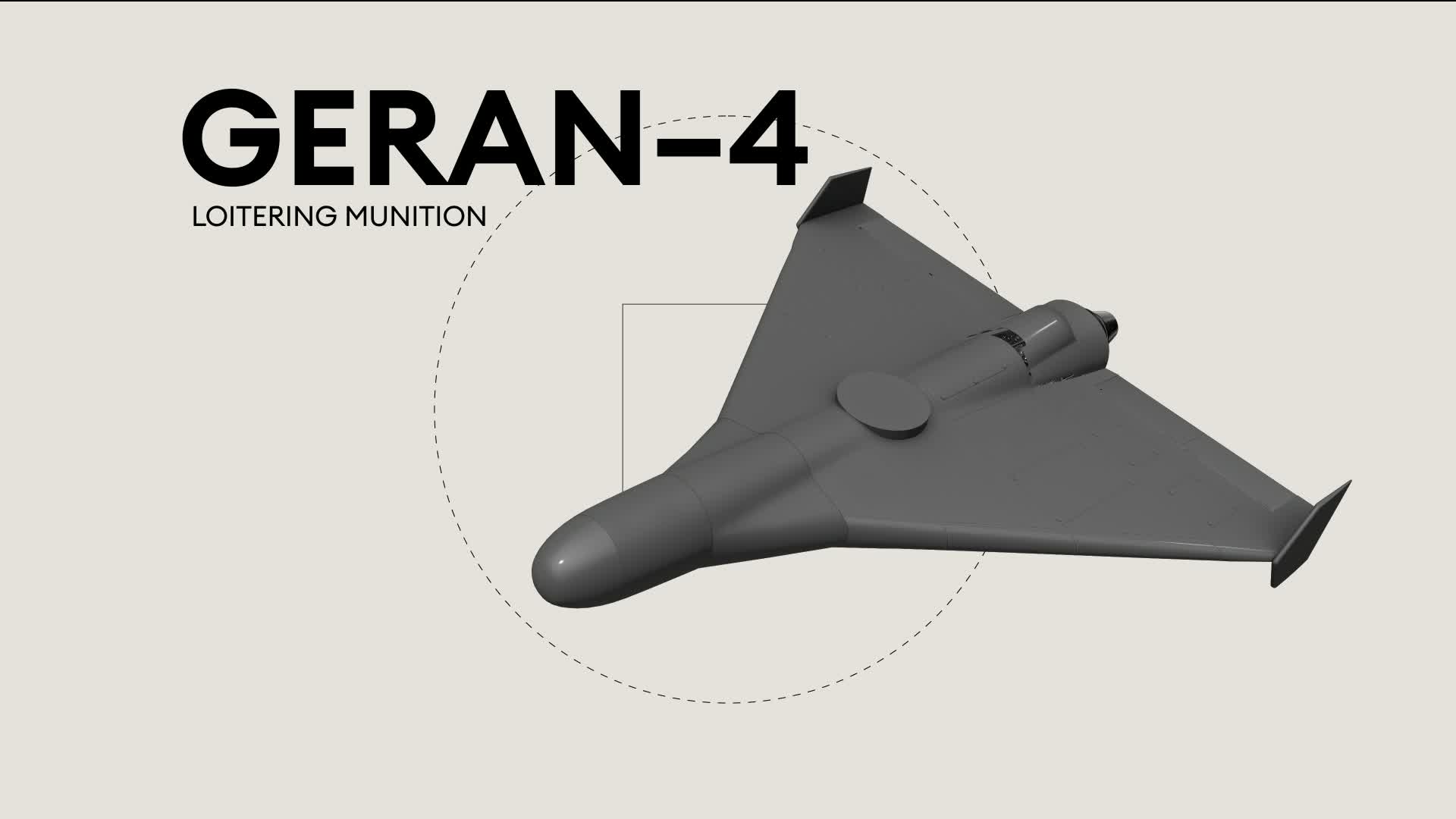
The Geran-4 retains the familiar shape of the Shahed, measuring around 3.5 metres long.
But its Chinese-made turbojet engine gives it a reported top speed of more than 300 miles per hour – roughly three times the speed of the piston-engined Shahed-136.
Its range is estimated at around 500 miles, but there are reports this increases significantly at higher altitudes.
It can also carry a 50-kilogram warhead, with different versions reportedly including high-explosive, thermobaric or incendiary payloads.
Ukrainian journalists who examined a recovered Geran-4 discovered consumer electronics from seven countries, including the United States, Germany and Japan.
Even its Chinese-made engine can be found on sale on e-commerce websites.
The drone also incorporates day and night cameras, alongside Chinese mesh-networking and cellular modems.
These components are thought to allow Russian operators to receive images, track the drone's position and adjust its flight while it is airborne.
That creates a more complicated threat than a drone simply following pre-programmed coordinates.
Ukrainian officials have also raised concerns that signal repeaters, hidden inside Kyiv by Russian agents, could be helping them maintain communications, potentially allowing the drones to be guided towards targets in real time.
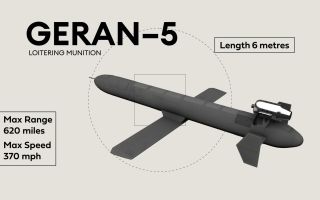
The Geran-5 takes things a step further. At around six metres long, it looks much more like a cruise missile than a conventional unmanned aircraft.
It uses a larger Chinese-designed jet engine, which has reportedly been repositioned inside the fuselage in newer versions. This reduces aerodynamic drag and helps the drone reach higher speeds, possibly 100 miles per hour faster than the Geran-4.
It can also carry a substantially larger warhead, potentially weighing up to 90 kilograms.
The problem for Ukraine is straightforward: the faster these drones fly, the less time defenders have to detect them, identify them and launch an interceptor.
Ukraine is developing several ways to counter the threat, starting with interceptor drones.
The Wild Hornets Sting interceptor has been upgraded with a faster S variant, which reportedly has the performance needed to engage more demanding targets.
There is also an opportunity to attack jet drones when they slow down to manoeuvre.
But Ukraine's longer-term answer is to build its own jet-powered interceptors capable of matching the speed of the Russian drones.
President Volodymyr Zelensky announced in late September that four such systems were entering service.
However, Russia is adapting too.
Reports suggest some Geran drones are being equipped with systems to detect approaching interceptors and accelerate away.
Ukraine can also use F-16 fighter jets, and footage has shown them engaging drones with their 20mm cannons.
But using expensive manned aircraft against waves of relatively cheap targets is difficult to sustain, particularly when hundreds of drones may be involved in a broader attack campaign.
Other options include missile-based systems. Ukraine is developing solutions that use existing air-to-air missiles, including the Soviet-designed R-73 and American AIM-9M, alongside its new ST-100 surface-to-air missile.
President Zelensky has also said Ukraine is installing anti-drone machine-gun turrets around Kyiv, with 12 reportedly in place.
The idea is to create a dense wall of fire against incoming drones.
Russia is working to make these weapons easier to produce at scale.
It has reportedly begun manufacturing its own versions of Chinese-designed turbojet engines at the Alabuga industrial complex.
Satellite imagery has also revealed a huge new launch facility, described as a droneport, around 250 miles inside Russia and reportedly capable of accommodating 500 jet-powered drones.
Putin has given his commanders considerable latitude to intensify attacks, and the Geran-4 and Geran-5 are likely to play a major role in that campaign.
For Ukraine, the challenge is not simply shooting down individual drones.
It is finding a way to defeat them in large numbers without exhausting its supplies of missiles, aircraft and other expensive defensive systems.
As winter approaches, that race is becoming increasingly urgent. Russia is building faster drones in greater numbers, while Ukraine is scrambling to develop interceptors and strengthen its air defences.
The question is whether Ukraine can adapt quickly enough to stop this next generation of Russian attack weapons from overwhelming its skies.
Related topics
Join Our Newsletter