'We shouldn't be doing enemy's job', former commodore warns over US carrier's 250 days at sea
Concerns are continuing to mount for thousands of sailors aboard the US aircraft carrier USS Abraham Lincoln, which has been on an extended deployment for more than 250 days.
Leaving California in November for the South China Sea, the Nimitz-class nuclear-powered aircraft carrier was sent to the Middle East ahead of February's attack on Iran, with the crew originally expecting the extended deployment to end in May.
According to reports, some sailors have attempted to jump overboard as thousands face food shortages and difficult conditions during the nine-month deployment.
Operational fatigue
Speaking to BFBS Forces News, retired Royal Navy Commodore Steve Prest explained that the issue lies in the prioritisation of stores needed to sustain the operation.
"Even though the Abraham Lincoln is an aircraft carrier and there will be opportunities to fly some stores on board aeroplanes that do that and can land on an aircraft carrier, they have a very limited capacity," he said.
"Stores for the aircraft to keep the aircraft flying or other parts for different systems on the ship; those will be prioritised potentially over fresh food. To fly on enough fresh milk for 5,000 sailors on board, it's a lot of toing and froing in the aircraft – there probably isn't the capacity."
There is also a limited amount of resupply available from other vessels, the former commodore explained, and these will be prioritised "ruthlessly".
"They will have ships that will come out, and they can do replenishments at sea and transfer stores, but those ships also will have to come from somewhere; they've got an operational tempo.
"They'll be servicing the whole of the fleet that's out there. It's not just about sending them to nip to the shops and come back."
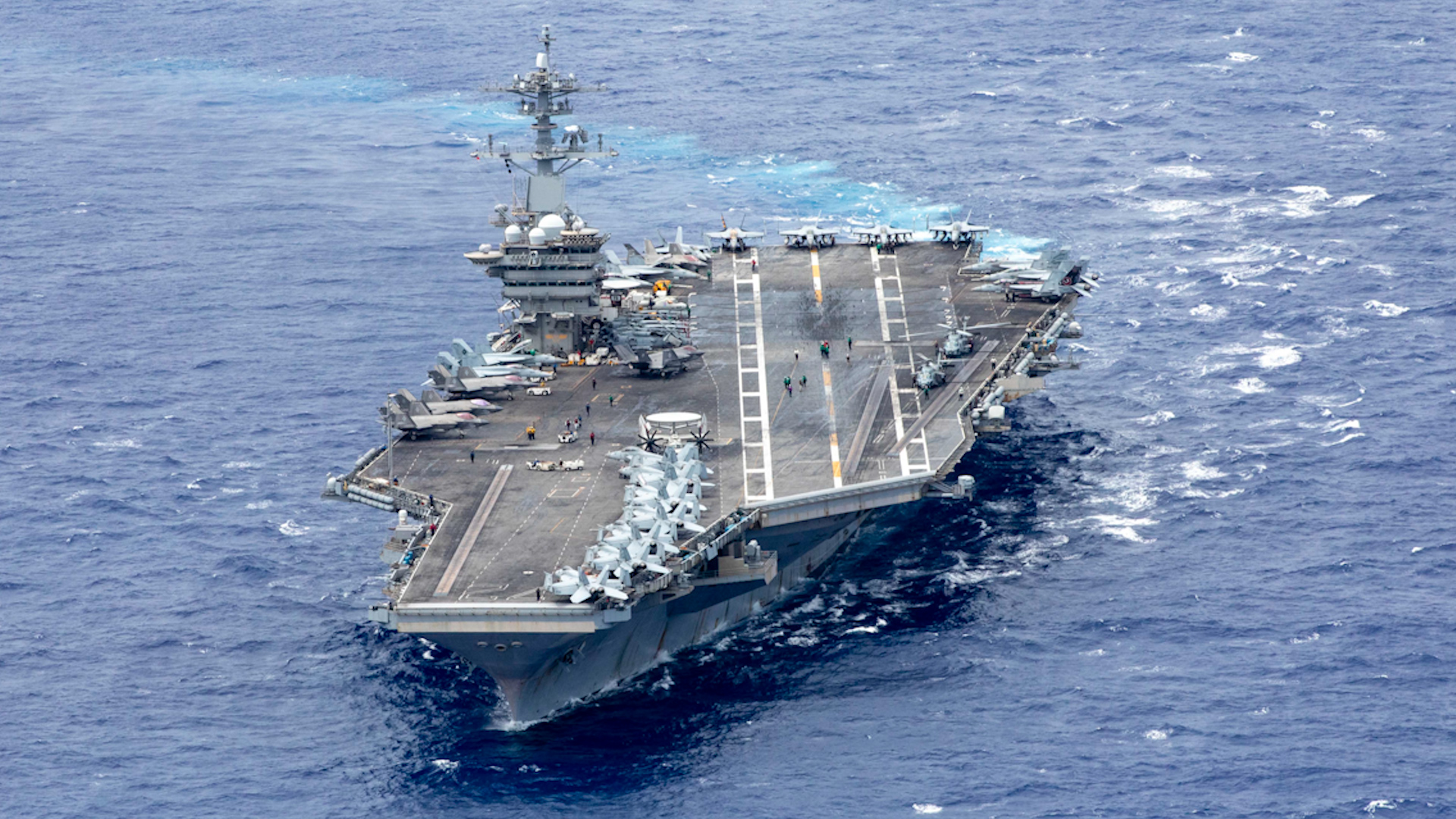
The challenge is balancing the needs of the thousands of crew on board with operational demands.
"Some of that will be food to sustain the sailors, but it will also be munitions for the aircraft," Cdre (Ret'd) Prest said.
"It will also be missiles and ammunition for the destroyers to make sure they can shoot down threats that are coming in, and it will also be spare parts, filters, replacement spares…and loo roll."
He added: "You cannot underestimate the importance of making sure when you're at sea, you don't run out of loo roll."
Beyond the food shortages, flagrant hygiene issues and exhaustion, the former commodore explained that during the round-the-clock flying operations, "most people can't get up and get any sunlight".
The demand for rest is as much to the benefit of the mission as it is to the people on board, he said, adding that fatigue leads to an increase in mistakes while on the mission – down to the chefs cutting themselves more frequently and needing medical attention.
These factors are separate from the engineering challenges facing a vessel that has been at sea far longer than expected.
"I always used to say that it is the enemy's job to do our people harm, and under no circumstances should we be doing the enemy's job for them," Cdre (Ret'd) Prest concluded.

Mental health a priority
While the US Navy has acknowledged supply challenges, it has denied that a mental health crisis was taking place on the Lincoln, which has 5,000 aboard.
In a statement posted on X, the commander of US Central Command (Centcom), Admiral Brad Cooper, said that supporting sailors' mental health remains a priority.
Following a visit to the carrier over the weekend, he said it had "among the lowest number of cases related to mental health" out of 11 active US aircraft carriers.
Nevertheless, he acknowledged that the conditions for those on board are "uniquely challenging and tough", noting that "every single one of us, including me, reacts to stressors in different ways".
"I've long believed that mental health is another aspect of individual health and requires our attention just like physical health and spiritual health," Adm Cooper said.
"I applaud Lincoln's leadership for... stepping up and making mental health and crew resilience a leadership priority."
The USS George Washington is reportedly heading to replace the USS Lincoln and could arrive in the region in about a week.
Related topics
Join Our Newsletter