Loyal service rewarded as Royal Regiment of Scotland receives Freedom of Inverclyde
The Royal Regiment of Scotland has become the first recipient of the Freedom of Inverclyde following a military parade beside the Clyde.
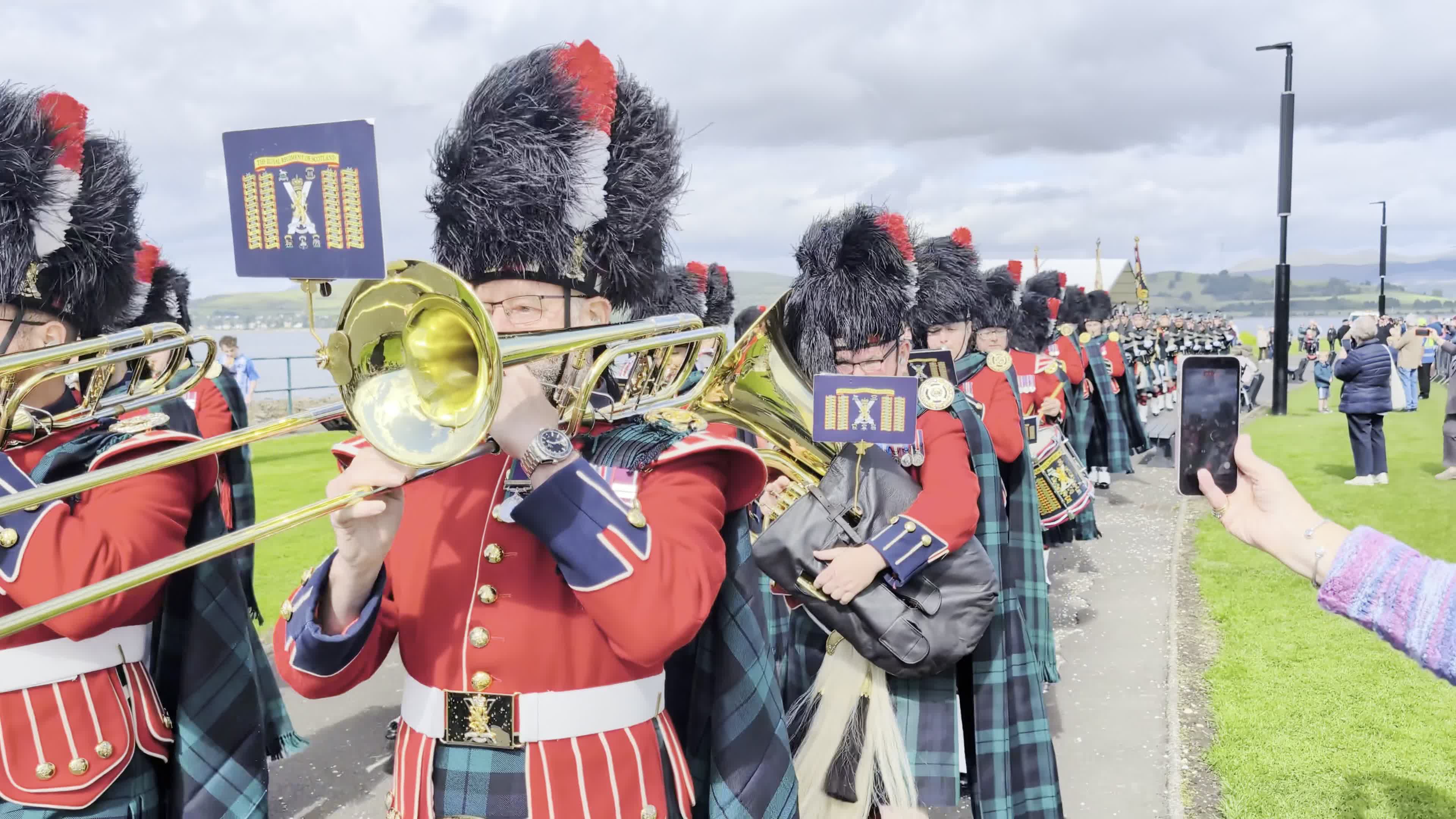
Around 100 serving personnel marched along Greenock Esplanade to Battery Park, including soldiers from 2nd Battalion, The Royal Regiment of Scotland.
They were accompanied by 2 Scots Pipes, Drums and Bugles, the Band of the Royal Regiment of Scotland.
- Royal Regiment of Scotland keeping traditions alive 20 years since infantry reforms
- A military welcome to Balmoral as the King begins his summer stay in Scotland
- Bronze lion takes guard in Edinburgh as King marks 20 years of Royal Regiment of Scotland
At Battery Park, Inverclyde Provost Drew McKenzie presented the freedom scroll to Major General Robin Lindsay, Colonel of the Royal Regiment of Scotland.
The parade later continued to Gourock Primary School.
Councillor Graeme Brooks, Inverclyde's Armed Forces Champion, proposed granting the freedom in 2025. Councillors unanimously backed his motion.
"The brave men and women of The Royal Regiment of Scotland come from our community here in Inverclyde as well as across Scotland," he said.
"Inverclyde has a long and proud history with the Armed Forces and this honour is for them as much as for those who are currently serving."
A 20-year-old regiment with much older local roots
The Royal Regiment of Scotland received the Freedom of Inverclyde during its 20th anniversary year.
The senior Scottish line infantry regiment was formed on 28 March 2006 by amalgamating six historic Scottish infantry regiments.
Among them were the Argyll and Sutherland Highlanders, formed in 1881 and whose connection with Inverclyde can be traced through generations of local soldiers.
The 5th (Renfrewshire) Battalion of the Argyll and Sutherland Highlanders was headquartered in Finnart Street in Greenock.
Six of its companies recruited in Greenock, with another drawing its soldiers from Port Glasgow and an eighth from Gourock.
The entire battalion had assembled by 5 August 1914 following the order to mobilise for the First World War.
It initially spent three months on the Clyde defences before serving at Gallipoli, in Egypt, Palestine and on the Western Front.
The link passed to the Royal Regiment of Scotland when the Argyll and Sutherland Highlanders became its 5th Battalion in 2006.
Today's regiment has served in many conflicts and peacekeeping missions worldwide, including operations in Iraq, Afghanistan and the Balkans.
What does the Freedom of Inverclyde mean, and how much did it cost?
The freedom is an honorary civic distinction that recognises the regiment's service, sacrifice and relationship with the area.
Under Scottish law, a council can bestow honorary freedom with the support from at least two-thirds of its members.
The local authority budgeted £25,000 for the event.
Military freedoms are commonly associated with permission to parade with colours flying, drums beating and bayonets fixed.
Maj Gen Lindsay said the recognition reflected the dedication of soldiers past and present as well as the regiment's relationship with the community.
"As we mark our 20th anniversary, this historic occasion is a proud moment for the entire regiment," he said.
Join Our Newsletter