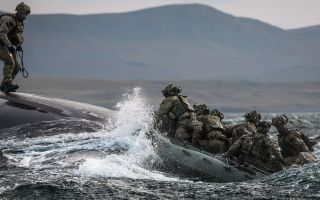
Block, blunt, break: What we'll do to the enemy if it comes to war, says Nato commander

Nato has announced a new defence strategy as the alliance looks to deter Russian aggression.
Nato's Supreme Allied Commander Europe, General Alexus Grynkewich, issued a warning to Moscow, setting out how Nato would win, should it be attacked.
But speaking at the Warsaw Security Forum, the senior US Air Force officer cautioned against the idea that the 32-member alliance was close to going to war.
"I do not assess that conflict is imminent or inevitable," he said, in light of recent alleged incidents of hybrid warfare across Europe.
General Grynkewich, who operated the F-16 Fighting Falcon and F-22 Raptor during his flying career, explained his three-pronged strategy to block, blunt and break adversaries.
"We will block the initial attack," he said. "If the attack persists, we will blunt it and prevent enemy advance.
"And if required, we will break the enemy's forces and the operational warfighting system that is arrayed against us."
The alliance's new fighting doctrine: how does it work
Block
The Nato commander said the alliance's land forces would seek to dominate any enemy assault at the point of contact and deny the capture of Nato territory.
Land forces would then destroy the enemy's advancing forces.
It would be a multi-domain strategy as Nato's navies and air forces worked with space and cyber forces to "rapidly gain freedom of manoeuvre".
Through this it is hoped that Nato would have air and maritime superiority over an adversary, making it harder for the enemy to keep hold of its territory.
Blunt
The alliance would then try to blunt the attack by using advanced sensors, autonomous systems and multi-domain forces.
"Their advance, if it is continuing at all at this point, will falter further," he said.
Break
If the enemy decides to call on their reserves, Nato would break the enemy, including everything that supports and sustains the adversary's force.
The force will deploy high-end precision munitions and a mass of affordable and scalable systems to break the enemy.
"We will apply constant and unyielding pressure, both kinetic and non-kinetic. We will do this across and through domains: land, air, sea, space and cyberspace," he said.
By seeking to break the enemy, the adversary will be unable to replenish its resources, commanders will be unable to lead forces, and support capabilities will be obliterated.
Related topics
Join Our Newsletter