Reshaping Army refuelling: How to resupply troops on the frontline without being spotted
A major British Army sustainment demonstration has highlighted the vulnerability of fuel supplies in the age of drones, with large fuel tankers proving an easy and high-value target.
Enemy forces are seeking to strike resupply convoys hundreds of kilometres behind the frontline to disrupt the flow of fuel and other essential resources.
On a north Yorkshire airfield, 102 Operational Sustainment Brigade and 6 Regiment RLC Royal Logistics Corps showed how deception could be used – 150 to 400km from the frontline.
Thermal cloaking was thrown over drone nets, in turn layered above a flattened, bladder-shaped container for vehicle fuel.
Next to this, several shipping containers held a hidden function too – with protruding refuel nozzles hidden by fake rubble and garbage.
From the view of an FPV drone camera lens, this could contain anything and appears unremarkable.
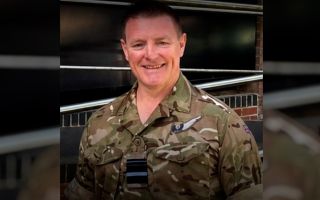
"The main threat is the UAS threat and our ability to counter that. Currently now, the reach is getting further and they can hit us in the rear area," said Major Lloyd Diprose, officer commanding 9 Fuel and GT Squadron, 7th Regiment, RLC.
"So it's how we protect our key commodities and move that to the front line without getting hit."
Vital frontline supplies
Mass and speed are crucial to keeping other troops in the fight further forward, he explained, but these supply forces must first protect themselves to do so.
"So on show today, there's been how we fight today with our current kit.
"The light forces system, for example, being hidden in a Nato standard container.
"And we can deliver that at speed on the equipment that we've got available to us and be able to hide it in plain sight or even in a rural landscape.
"We could hide it under some of the netting and some of the protective sheeting.
"There's definitely options for us to be able to with the fuel containers and drop it forward and hide it and then leave it there for the people to then come back when it's required for them to then take what they need from that dead drop."
The demonstration also featured land drones autonomous resupply, casualty evacuation, equipment recovery, fuel distribution, deception capabilities and digital integration across 3rd, 2nd, and 1st Line support functions, highlighting how innovation is reshaping operational sustainment.
Being able to stay on the move is crucial, but doing it safely is not easy.
"So we need to find ways of moving our fuel safely and that could be by using a blend of white fleet, civilian tankers or, of course, our own current transport," said Maj Diprose.
The thermal cloaking on display goes some way in helping stationary resources avoid detection.
"If we can hide (fuel storage) in plain sight or even in a rural environment that gives us a chance to protect it and be able to then sustain the battlefield and the fight."
Related topics
Join Our Newsletter