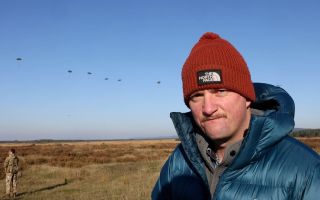
In southeastern Ukraine lies Zaporizhzhia, a city scarred by Russian missile and drone attacks, and where journalist and author Colin Freeman travelled to meet British volunteers who have left home to fight alongside Ukrainian forces in the war against Russia.
Speaking on the threat of drones with BFBS Sitrep's host Kate Gerbeau, he looked relaxed and composed, seemingly unfazed by the dangers surrounding him. Just days earlier, the bright red streak of one had cut across the sky near his hotel, followed moments later by the sound of anti-aircraft gunfire and the boom of an explosion.
Just minutes into the interview, a distinctive rushing sound came to bear once again in the background. "I'm going to take a quick break," Mr Freeman says, stepping away calmly to the nearby bathroom – the closest point of cover, away from his bedroom window.
A few seconds later, a deep boom signals the impact.
Daily life amid the war
While terrifying, such sounds have become daily life for those living in the city on the banks of the Dnieper River.
The foreign affairs writer likened it to hearing a lightning strike as he coolly resumed the interview, insofar as "there's nothing we can do".
"You imagine that everybody would be dashing down to the air raid shelters all the time," he explained. "But in reality, in Zaporizhzhia, as in Kyiv and many other cities, you get air raid alerts all the time.
"People have just come to live with them, and the vast majority of people just carry on about their ordinary business."
According to Ukraine's Air Force, Russian forces launched an S-8000 Banderol drone-launched cruise missile and 161 Shahed drones across the country on the night of 10-11 September, 138 of which were destroyed.
In the capital Kyiv, a record level of airstrikes has led to the introduction of a two-tier warning system, which allows public transportation and some businesses to continue operating during lower-level drone threats.
"I can pretty much guarantee you that outside the hotel right now, when people would have heard that sound that we just heard, nobody would probably be batting an eyelid," Mr Freeman continued.
"They'd be looking up and thinking, well, there's nothing we can do."
Asked what produced that sound, Mr Freeman could only speculate. He suggested it could be a missile or one of Moscow's new upgraded Geran drones.
Jet-propelled, the upgraded munitions can cruise at more than 300mph, significantly faster than older models and well beyond the top speed of Kyiv's interceptors.
In his short time in the city, he had heard four or five sounds similar to what he had just heard, in addition to other drone attacks.

A battlefield suited to youth
Mr Freeman travelled to Zaporizhzhia specifically to talk to British volunteers fighting for Ukraine, where he said most of the foreign military contingent currently lives.
"They include Brits, Americans and various other nationalities, and quite a large contingent of Colombian volunteers as well," he said. "They've all enrolled into the Ukrainian military."
Those who have lived there for years spoke about how the battlefield has changed.
"Some are almost wistful for the old days of artillery, gunfire, and meat wave assaults, because while it was very, very, tough soldiering, it was soldiering of a sort that they knew and recognised," explained Mr Freeman.
"Whereas now you have the drone threat everywhere. You have FPV (first person view) drones, kamikaze drones that can pursue people on the battlefield, and whenever you go into the open you have to expect that you're being monitored by the Russians and potentially targeted quickly after."
Despite being "amazed" that foreign combatants are still fighting in Ukraine, Mr Freeman said they are adapting fast to the expanding drone threat and spending far less time on the front line than previously.
"What the Russians are trying to do to them in terms of FPV drones and so on, they are doing to Russians as well," he said.

Because of this threat, Moscow has reduced the troop numbers needed for attacks, often to as little as a single person.
"Because even a small group of Russians, three or four… kind of infiltration tactics in small numbers, even that is enough to be detected these days," Mr Freeman added.
Those he spoke to in the city of Zaporizhzhia were experienced soldiers, he said, including one individual who had been living there since 2022.
"But he says back then there were a lot more people with direct experience of Iraq and Afghanistan. Quite a lot of the people who are coming out now have never had previous combat experience at all," he recalled.
"Given that it's getting on for a decade and a half since Britain was in Afghanistan, that's perhaps not surprising. But they did say that the skill set has changed anyway.
"You've got a young, technically minded 21- or 22-year-old who may be much more suited to this kind of drone warfare, with it all being based around iPads and technology and gaming formats to some extent than some of the old warhorses who grew up in the days of SLRs."
Morale on the frontline
Mr Freeman continued that not much had changed since he visited the city six months ago. Nevertheless, he said, "there's a sense that Ukraine is in a slightly better position militarily.
"They got through a very, very difficult winter last year where Putin seemed to be doing his best to destroy the power supplies.
"It was very cold, down to minus 25°C, and there was a sense that he was trying to crush the Ukrainian morale.
"Once they came out of that, once spring began to blossom, there was a sense of, like, look, he's thrown everything he can at us, we're still here, bring it on. And the battlefield conditions have sort of changed a bit in favour of Ukraine since then.
"But people are already talking about this coming winter as well. Will he try the same thing again? The energy infrastructure that he weakened last time is potentially going to be made even weaker this time."
With Moscow unable to breach Ukrainian defences outside the cities, they are instead harassing the civilian population through the use of air power, "whether it’s drones like that one we just heard, or it's FPV drones," Mr Freeman said.
"And in the last sort of six weeks or so, a couple of months in Zaporizhzhia, there's been a growing number of FPV drones being used, dropping in and attacking coffee shops, bus shelters, buses as well.
"And it just, you know, appears to be a sort of concerted campaign to make civilian life here unpleasant."
You can listen to BFBS' Sitrep wherever you get your podcasts, or on BFBS Forces News YouTube channel.
Join Our Newsletter