Canadian Forces Station Alert: The most remote outpost in the High North

A Royal Air Force aircraft has just been part of a mission to resupply a desolate base at the top of the world.
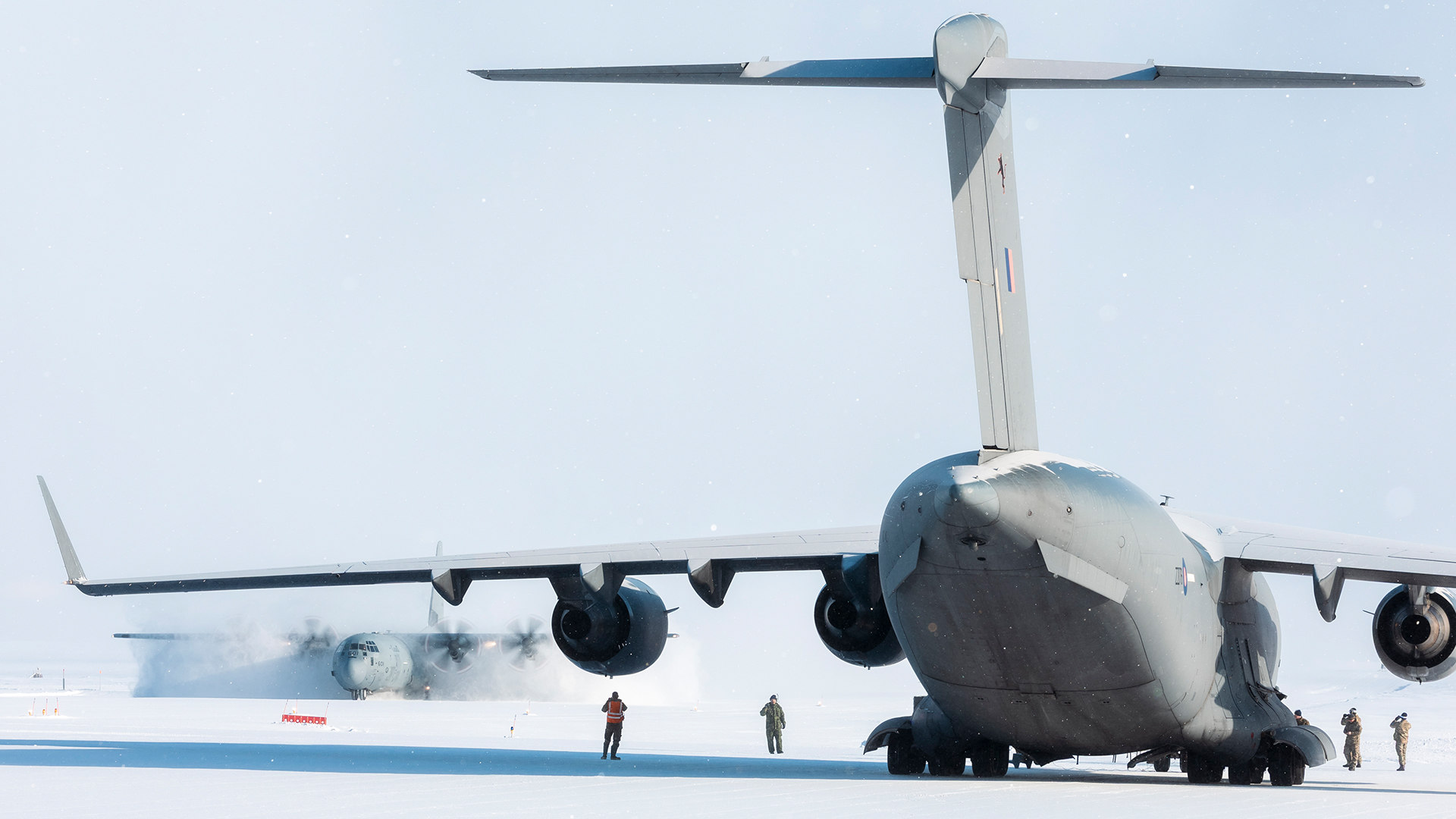
A RAF C-17 Globemaster flew to Canadian Forces Station (CFS) Alert, which is found at the north-eastern tip of Ellesmere Island, to deliver fuel and supplies.
The flight was part of Canada's regular resupply operation for CFS Alert, known as Operation Boxtop.
The C-17, which can hold up to 45,360kg of freight, landed on a semi-prepared runway of gravel and compacted snow after staging through Pituffik Space Base in Greenland.
BFBS Forces News has taken a look at the station that is the world's northernmost permanently inhabited place.
Station's role
The station helps military operations in the far north, including signals work, search and rescue, and it also aids Arctic research and weather monitoring.
The Canadian air force has been running the base since 2009, and it is part of 8 Wing.
The personnel deployed at the base include the Canadian armed forces, department of national defence employees, like the UK's Ministry of Defence, and Canadian environment and climate change employees.
Considering the improvements in technology, there has been a decrease in personnel, with around 55 military and civilian personnel currently living in the barren landscape.
The personnel are deployed there for half a year, while other more specific positions are changed once every 12 weeks.
If Canadian military personnel work for 180 days doing "honourable service" throughout their deployment at the base or are operationally deployed there, they are able to obtain the Special Service Medal, according to the Canadian government.
Location and the environment
CFS Alert, which is 817km from the North Pole, is so remote that the town closest to it, Grise Fjord, is a journey of only 725km.
Other settlements in its region are Eureka, roughly 400km south; Edmonton, Alberta 3,475km away, and Stockholm, in Sweden, a couple of hundred kilometres closer at 3,282km. So, on the face of it, a hop, skip and a jump, and it's back into civilisation.
Considering the base's location, it is surrounded by hills and valleys, and Greenland can be seen from the base. Meanwhile, pack ice floats in the Arctic Ocean in the summer, and ice covers everything to the horizon during the winter.
The area is also home to a vast array of wildlife, including seals, arctic wolves, musk-ox, caribou, lemmings, and weasels.
Canada and the High North
The High North has become an increasingly disputed region this year, following US president Donald Trump's threats to annex Greenland, the semi-autonomous region governed by Denmark, back in January.
Its status was underlined as the First Sea Lord General Sir Gwyn Jenkins said at the end of April that the security of the High North and North Atlantic depends on the UK's ability to work together with its allies, permanently at pace, ahead of a meeting of the Joint Expeditionary Force's naval chiefs in Whitehall.
The importance of the region is shared by both London and Ottawa, as noted in the foreword to a policy document on Canada's Arctic foreign policy.
"Canada must urgently strengthen our presence in the Arctic and northern regions as our adversaries aspire to a greater role in the region's affairs," then-national defence minister, William Sterling Blair, said two years ago.
"The physical threat of climate change is compounded by challenges from authoritarian states to the rules-based international order that Canada and its allies strive to uphold."
The UK will deploy a Carrier Strike Group under Operation Firecrest to the North Atlantic and the High North, led by the Royal Navy's flagship, HMS Prince of Wales.
The CSG will work with the US, Canada, and other Nato allies after the MOD said that incidents of Russian vessels threatening UK waters have increased by a third in the last two years and that submarine activity in the North Atlantic is now back to the same levels as the Cold War era.
In March, Ottawa's prime minister Mark Carney, visited Bardufoss and Oslo in Norway to improve cooperation with Nordic countries on defence and Arctic security.
Mr Carney attended the Canada-Nordic Summit in Norway, where he met leaders from Denmark, Finland, Iceland, Norway, and Sweden to reinforce efforts to strengthen transatlantic security in the North.
"The Arctic and the High North are central to Canada's national identity and strategic autonomy," the former governor of the Bank of England said.
"Canada is intensifying our cooperation with trusted Nordic partners to bolster Arctic and transatlantic security, build economic strength at home, and catalyse massive opportunities for Canadian businesses and workers."
Related topics
Join Our Newsletter