As the light began to fade over Portsmouth Harbour, the gargantuan silhouette of HMS Prince of Wales came into view, with friends and family gathered along the waterfront to welcome her home following the completion of her Nato mission.
Over the past six months, the flagship of the Royal Navy has played a key role in operations spanning the Arctic, North Atlantic, and the High North under the second phase of Operation Firecrest.
And as one aircraft carrier arrived, another departed. HMS Queen Elizabeth left in the early hours of 16 November to resume her key role as Nato command ship for the Allied Reaction Force.
Marking the first case of one in, one out for the two Elizabeth-class carriers, it made for an unusually packed affair in the harbour for this time of year.
Captain Ben Power, Commanding Officer of HMS Prince of Wales, said it had been an incredibly busy period for the carrier and her company, but they have relished the opportunity of delivering Op Firecrest as the flagship of the UK's Carrier Strike Group (CSG).
"I am deeply proud of their professionalism, passion and determination to defend their nation," he added. "I am also hugely grateful to our families for all their support too."
Six months, two phases
With a mission to deter Russian aggression, protect vital undersea infrastructure and demonstrate warfighting readiness alongside Nato allies, Op Firecrest 2.0 saw the ship's company undertake a series of demanding engagements.
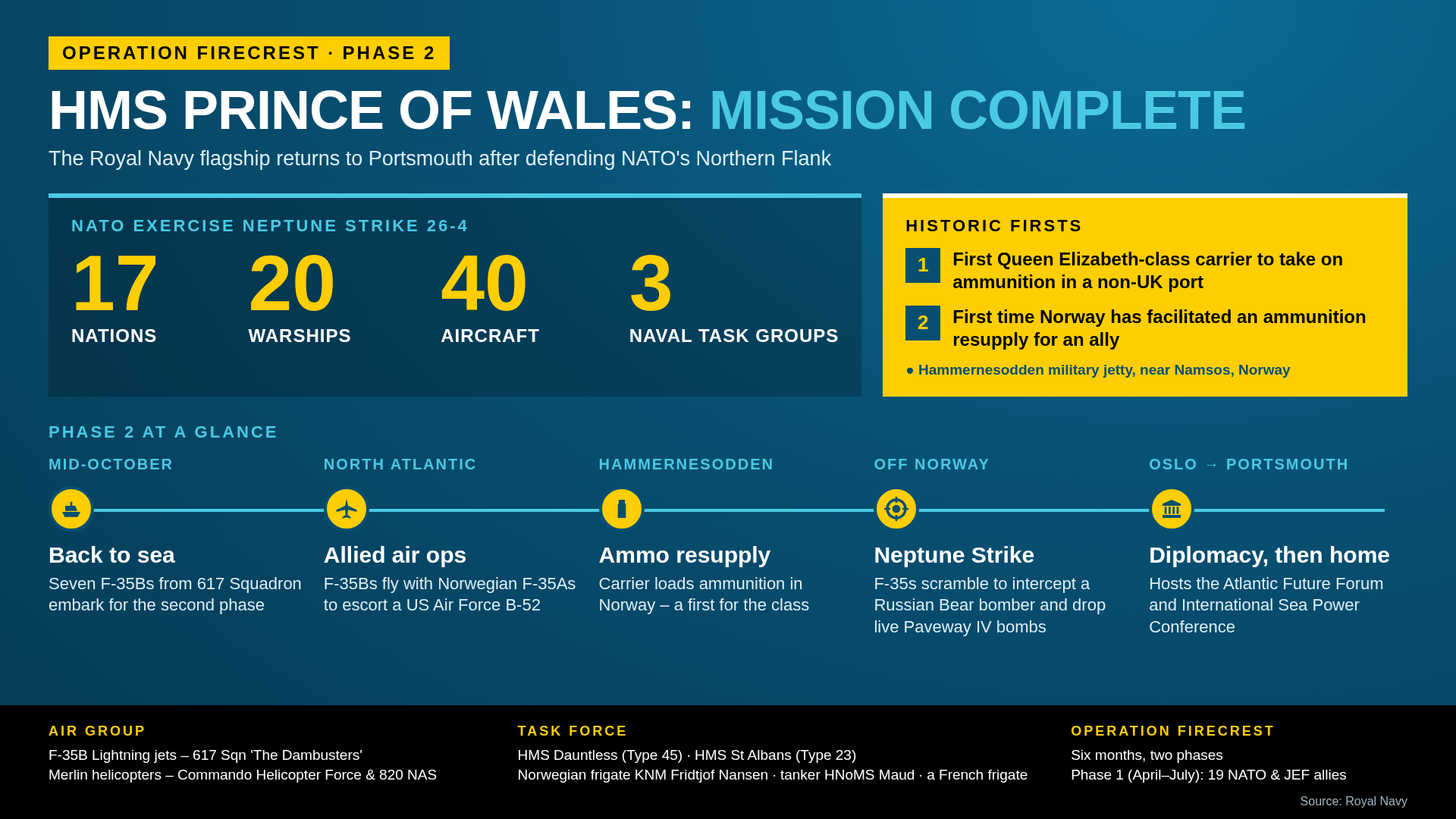
The first phase of the six-month deployment, running from April to July, saw the CSG work alongside 19 Nato allies and the Joint Expeditionary Force (JEF), playing a key role in strengthening the defence of Nato's northern flank.
You can read more about the first half of the deployment here.
Following a routine maintenance period, she returned to duty in mid-October for Op Firecrest 2.0, this time accompanied by Type 45 destroyer HMS Dauntless and seven additional F-35B Lightning jets from 617 Squadron.
Exercise Global Thunder saw the squadron called to action over the North Atlantic, working alongside Norwegian F-35As to escort a US Air Force B-52 Stratofortress bomber in a historic milestone.
And the firsts don't just stop there.
Shortly after, the 65,000-tonne aircraft carrier loaded ammunition at the military jetty in Hammernesodden, roughly 70 miles north of Trondheim.
It marked the first time a Queen Elizabeth-class carrier had taken on ammo in a non-UK port, and the first time that Norway had facilitated an ammunition resupply for an ally.
Just days later, alongside HMS St Albans, she and her air group of F-35s and Merlin helicopters took part in Ex Neptune Strike 26-4, the fourth and final enhanced vigilance activity of the year.
It involved three naval task groups: two in the Mediterranean under Italy and Turkey, and a third under HMS Prince of Wales off Norway.
With around 20 ships and 40 aircraft from 17 nations, the exercise integrated maritime, air, land, cyber, and space forces to demonstrate deterrence and collective defence, and even drew the attention of Russia.
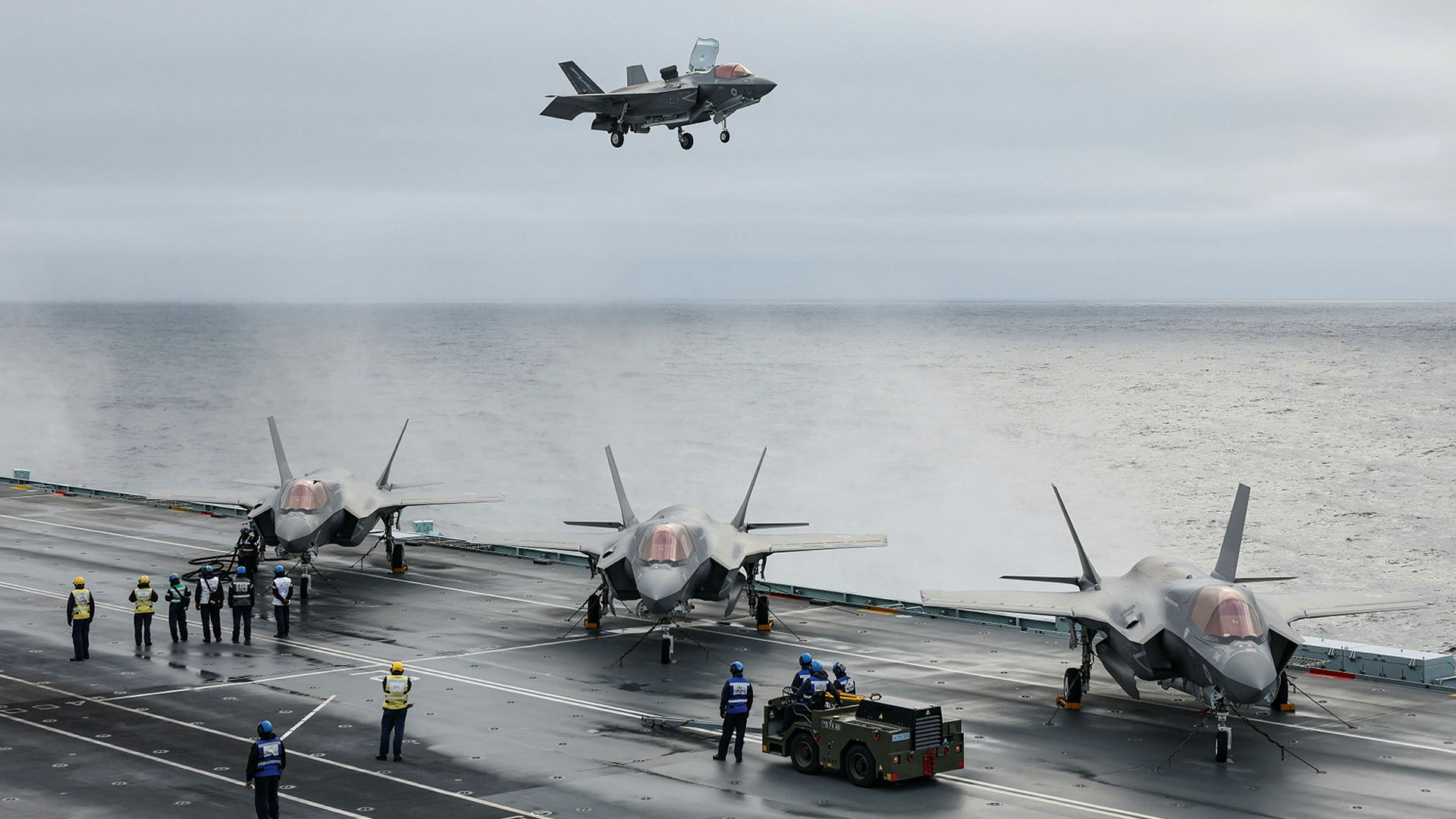
HMS Prince of Wales scrambled her F-35s to intercept a Tu-195 Bear long-range bomber, the Royal Navy said at the time.
Otherwise, the Lightning IIs have been performing their strike role, practising loading – and ultimately dropping – live Paveway IV bombs as part of the Nato exercise.
On conclusion of Ex Neptune Strike, she and her company headed to Norway's capital, Oslo, for the Atlantic Future Forum and the International Sea Power Conference, where European military and political leaders discussed the collective security of Northern Europe.
BFBS Forces News reporter Claire Sadler joined the three days of talks aboard the flagship. You can read her insights here.
Home sweet home
Commodore Richard Hewitt, Commander of the UK Carrier Strike Group, said the operation demonstrated the strength of Nato integration, and the value of a persistent maritime presence in the North Atlantic and High North.
"Throughout Phase 2, HMS Prince of Wales, HMS Dauntless, HMS St Albans, and our Nato partners have operated seamlessly together, deterring potential adversaries, defending the Alliance's northern flank, and enhancing our collective warfighting readiness," he said.
"From conducting complex air operations alongside Norwegian and US forces to hosting strategic engagements with military and political leaders in Oslo, this deployment has showcased the Carrier Strike Group's ability to generate credible military effect while delivering strategic influence wherever required.
"It has reaffirmed the United Kingdom's commitment to Nato, strengthened interoperability with key allies, and demonstrated the agility, reach, and relevance of Carrier Strike in today's security environment.
"I am immensely proud of our people. Their professionalism, dedication, and unwavering commitment have been at the heart of every success, ensuring that the Carrier Strike Group continues to deliver wherever the mission demands."
Join Our Newsletter