Hornet drones on the hunt for targets as they patrol Russia's Highway of Death
Ukraine is operating a drone that's super quiet and is able to navigate without GPS, making it hard for the Russians to spot and engage.
So in the drone war with Russia, the Hornet stands head and shoulders above the rest.
This one-way attack drone has been widely used by the Ukrainian military to disrupt the Russian ground lines of communication into Crimea.
Multiple Hornets on patrol
The Hornet was designed in Silicon Valley by Perennial Autonomy, which was awarded a $500m contract by the US military in May to build one way attack, surveillance and interceptor UAVs.
The Hornet was developed to penetrate frontlines by using a downward-facing camera linked to a processor, allowing it to navigate by comparing the terrain below to stored mapping data.
It then only transmits data from far behind the Russian frontlines, using non-standard radio frequencies to communicate with the operator and send back imagery.
Videos from southern Ukraine show so many Hornets patrolling the highway linking Russia to Crimea that the drones are passing each other in mid-air.
In other footage a Russian truck can be seen dodging a Hornet at the last moment over what has become known as the Highway of Death.
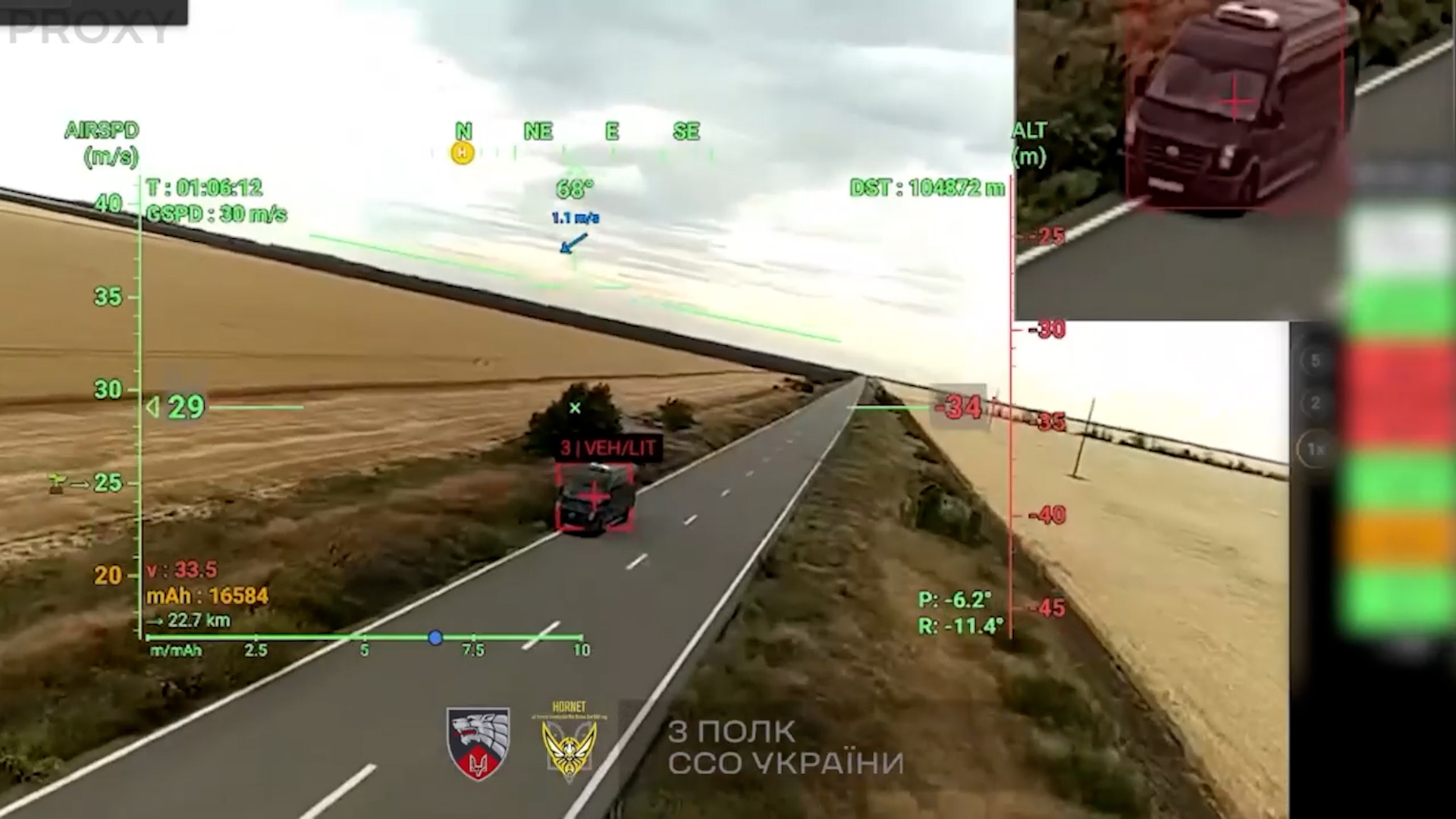
Hornets on the hunt
The Hornet is believed to have a range of more than 90 miles, but trials have been shown of one being dropped from a Kettle Tech labs balloon at a height of 25,000ft, which is thought to increase the range by over 40 miles.
As the Hornet searches its allocated zone with its second, targeting camera, the onboard AI compares vehicles with a database in the processor attempting to identify targets.
In the accompanying video you can see the AI designating the target from "Manual" to "Unknown" to "Veh Arm", standing for Vehicle Armour, before it strikes.
The fuselage is believed to be made from foamed polypropylene which is lightweight, has a high strength to weight ratio and is used in commercial packaging and some remote-controlled aircraft.
The Russians are countering the drone strikes with their own interceptor UAVs but the Hornet's speed and stealth mean many still get through.
Air defence assets are spread along the logistics routes by the Russians – but these then become the Hornets' primary targets.
The Hornet drone has a wingspan of 2.2 metres and is believed to cost about $5,000 dollars, so is very cost effective compared to other attack methods.
Does the UK military have anything close to this system and if not should we be training with the Hornet now?
Related topics
Join Our Newsletter